
Phrabbit User Guide
Phrabbit is an A/B loop app for foreign-language listening practice. Add audio files, video files, Music library tracks, podcasts, or YouTube links as study material, then repeat the exact section you want to hear, shadow it with your own voice, or write it down in dictation. You can also use speech-to-text subtitles, Wordbook review, saved shadowing recordings and dictation attempts, and learning stats.
Note: Button names in this guide follow the English UI used in the app. Some labels may appear localized depending on your device language.
This guide describes Phrabbit 4.1.0. Player layouts adapt to the available iPhone or iPad window width.
Contents
- Getting Started
- Home and Library
- Adding Study Material
- Audio Player
- A/B Loop
- Bookmarks and Loop Lists
- Speech-to-Text (STT) Subtitles
- Editing, Translating, and Adding Subtitles
- Wordbook
- YouTube Stream Practice
- Video Files
- Shadowing Recording and Comparison
- Dictation
- Podcasts
- Learning Stats and Settings
- Free vs Premium
- FAQ
1. Getting Started
1-1. First Launch - Onboarding
When you open Phrabbit for the first time, onboarding introduces the basic flow.
- Waveform and A/B looping - See the audio visually, set point A and point B, and repeat just that section.
- Subtitles, Wordbook, and review - Read subtitles, save words you want to remember, and build a learning history.
On the last screen you can choose one of two actions.
| Button | Description |
|---|---|
| Try with a sample | Opens a sample audio file and walks through the player tutorial |
| Skip | Goes directly to the Home screen |
1-2. Free Trial
After onboarding, a 3-day free trial begins. During the trial, you can try Premium features freely. While the trial is active, a Trial banner appears near the top of the player, and tapping it opens the Premium purchase screen.
2. Home and Library
The Home screen collects all study material you have added. Local audio, video files, Music library tracks, podcast episodes, and YouTube links appear together in the same library list.
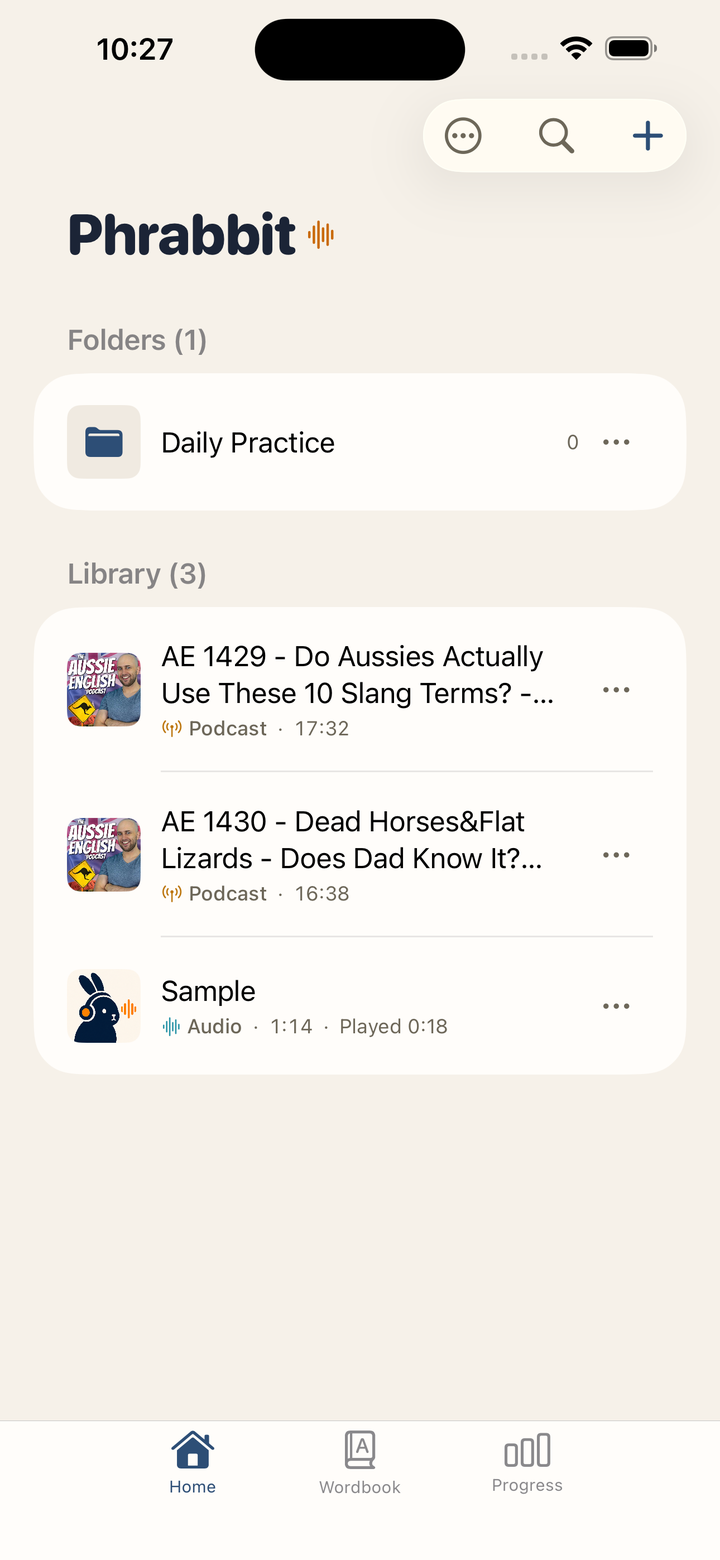 ▲ Home screen showing files, podcasts, and YouTube items together
2-1. Screen Layout
| Location | Element | Description |
|---|---|---|
| Header | Phrabbit wordmark | Scrolls into a compact title as you move down the list |
| Top right | Plus button | Opens the add menu |
| Top right | Search button | Opens library search |
| Top right | More button | Opens Settings and library organization commands |
| Below the wordmark | All / Favorites | Filters the library after at least one item is marked as a favorite |
| Upper middle | Recent | Appears when you have at least two recently practiced items |
| Middle | Library | Shows all study material |
| Bottom | Home / Wordbook / Progress | Switches between Home, Wordbook, and Progress tabs |
If the library is empty, you can use the centered Add button to add material right away. After you add at least one item, a small hint may point to the plus button once. Settings is now under the More button rather than a separate gear button.
2-2. Favorites and Folders
Tap ⋯ at the end of a library row, or touch and hold the row, to open the same management menu. Choose Add to Favorites to star it, or Move to Folder… to organize it. For a regular library item, Info shows the full title and details that may not fit in the row, such as its type, duration, play position, added date or segment count, and folder location. A folder’s menu contains Rename, Move to Folder…, and Delete.
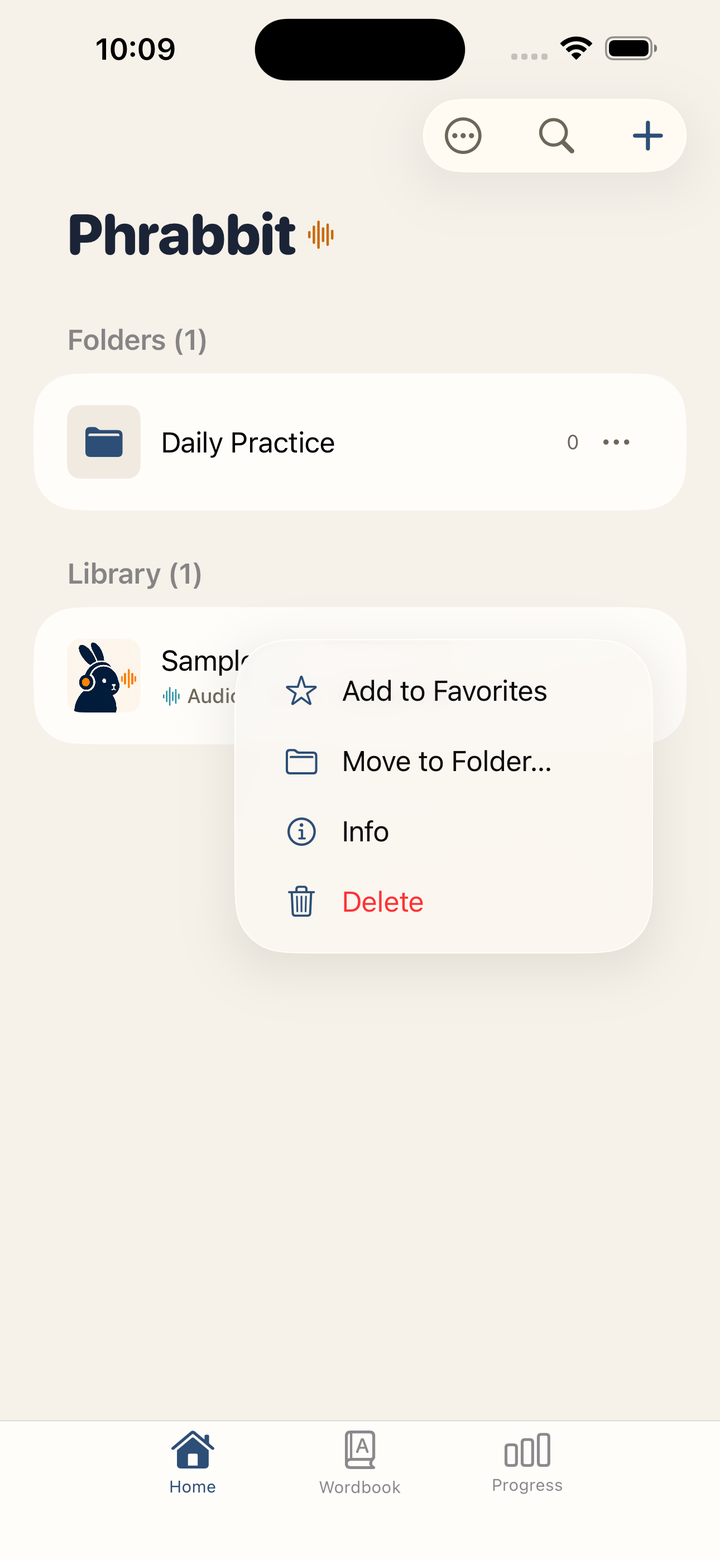 ▲ The same menu opens from the visible ⋯ or from touch and hold
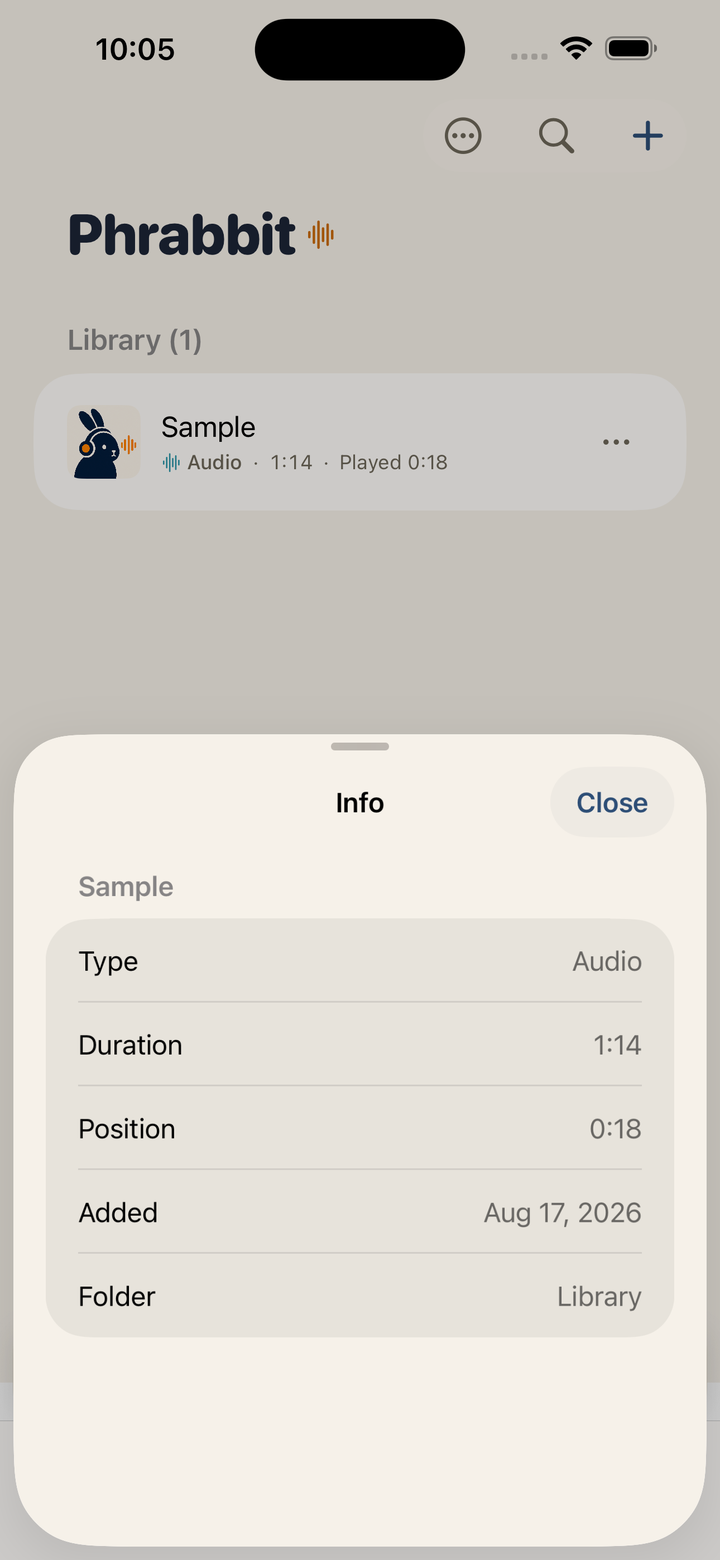 ▲ Info shows what the row itself has no space for
Once at least one favorite exists, the All / Favorites chips appear below the wordmark; Favorites shows a flat list across the whole library, regardless of folder.
Use More > New Folder to create folders. When folders exist, More > Select lets you select multiple items and move them together. While selecting, Select All at the top left picks every file and folder in the list you are viewing; tap it again (Deselect All) to clear the selection. Moving a folder moves everything inside it. All Items opens the whole library in one list. Folders can contain other folders.
You can also select and move search results. After typing a search, tap More > Select (in All Items, the Select button at the top right) to pick results from different folders at once and move them into one folder. If you have no folders yet, you can create one on the screen where you choose the destination. Changing the search clears the selection.
2-3. Item Types
Icons and thumbnails help you identify each item type.
- Waveform icon - Audio imported from the Files app
- Music note icon - Track imported from the Music library
- Antenna icon - Podcast episode
- YouTube thumbnail or play icon - YouTube stream
- Film icon or video thumbnail - Video file on your device
Tap an item to open its player. Audio items open the audio player, YouTube links open the Stream player, and videos open the video player.
2-4. Delete
Tap ⋯ at the end of a library row, or touch and hold the row, then choose Delete. Swiping a row does not reveal management actions. The visible ⋯ button and the touch-and-hold gesture always show the same menu.
Deleting an item also removes its waveform cache, bookmarks, subtitles, saved shadowing recordings, and dictation attempts. If the item has saved recordings, a confirmation appears first. When deleting a folder, you can choose whether to remove only the folder or the folder and everything inside it.
2-5. Sort Order
On Home or inside a folder, open More (⋯) > Sort By at the top right to choose the library’s sort order. Checkmarks show the selected criterion and direction.
| Sort criterion | Description | Default direction when selected |
|---|---|---|
| Recently Played | Recent playback or activity; the default criterion | Newest First — most recent first |
| Date Added | Date the material was added to the library | Newest First — newest first |
| Name | Item name | A to Z — ascending |
| Duration | Total length of the material | Shortest First — shortest first |
Two directions appear below the criteria. For dates, choose Newest First / Oldest First; for names, A to Z / Z to A; for duration, Shortest First / Longest First. Tapping the checked criterion again also reverses the direction. Choosing a different criterion starts with its default direction in the table above.
Your choice is saved and applies to Home, every folder, search results, and All Items. You do not need to set it separately for each folder. The Recent row keeps its recent-first order regardless of this setting.
Folders always appear above the material. Under Name, they follow the selected name direction; under Date Added, they follow their creation date and the selected direction. Under Recently Played or Duration, folders appear in ascending name order. Items with an unknown duration, such as YouTube links you have never opened, appear at the end of the material list in either Duration direction.
3. Adding Study Material
Tap the plus button at the top right of Home to open the add menu.
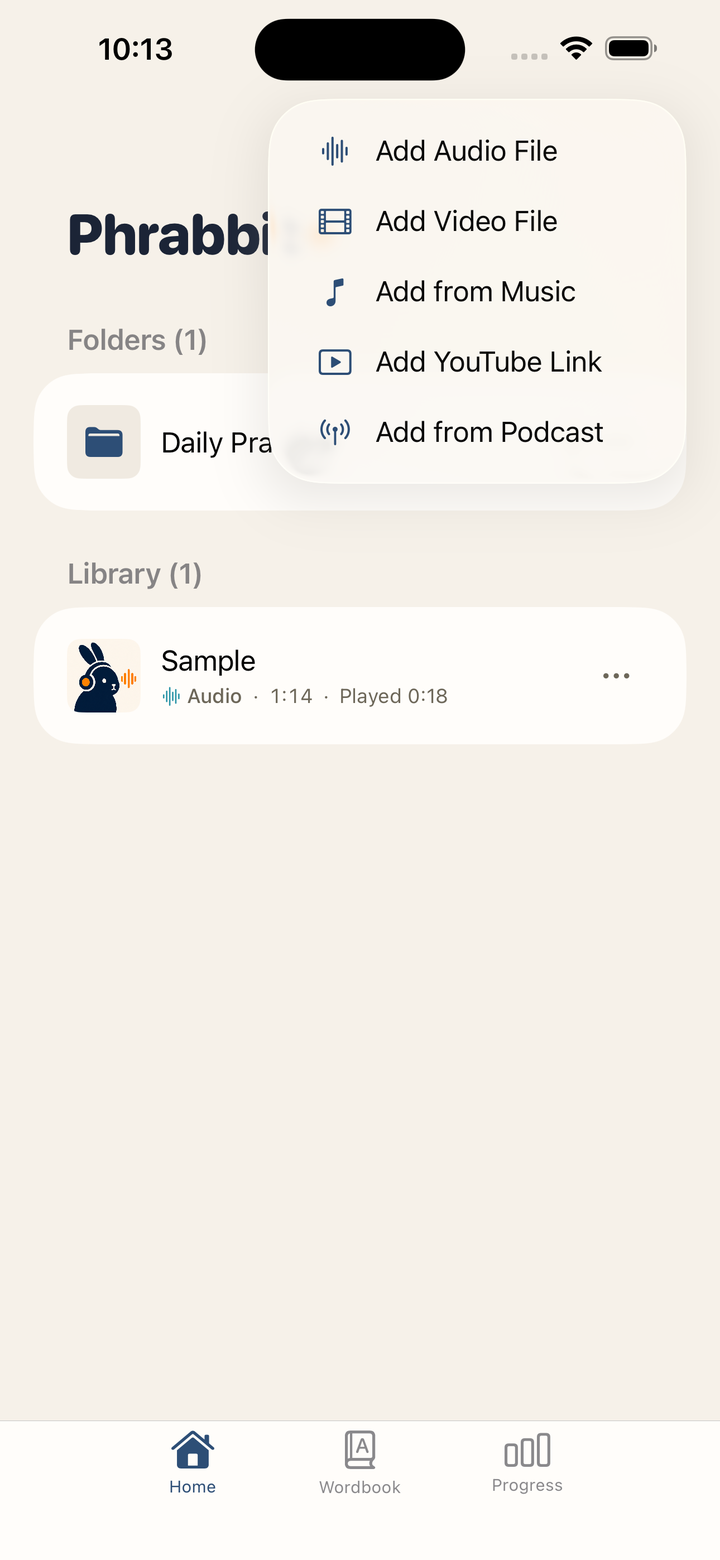 ▲ Menu for adding files, music, YouTube links, and podcasts
3-1. Add an Audio File
Tap Add Audio File to open the system file picker. You can import audio files such as mp3, m4a, wav, and aac, and you can select multiple files at once. Imported files are copied into Phrabbit’s Documents area and added to the library.
3-2. Add a Video File
Tap Add Video File to choose a video stored on your device or in iCloud Drive. MP4, M4V, and MOV files can be used, and this is a free feature.
The video file itself is not copied into the app. Phrabbit keeps only a link to the original file, so the video stops playing if that file is moved or deleted. See 11. Video Files for details.
3-3. Add from Music
Tap Add from Music to open the music stored on your device.
- Tracks already added to Phrabbit are shown with a check mark.
- Tracks downloaded through an Apple Music subscription cannot be imported because of DRM.
- DRM-free tracks you purchased or ripped from a CD can be used.
When you tap a track, Phrabbit prepares it in a playable format, adds it to the library, and opens the player.
3-4. Add a YouTube Link
Tap Add YouTube Link to open the YouTube link entry screen.
- In the YouTube app or a browser, tap Share on the video.
- Tap Copy Link.
- Return to Phrabbit and tap Paste.
- Confirm the thumbnail and tap Add.
The video is streamed through YouTube’s embedded player and is not downloaded into the app. Phrabbit saves the link, playback position, bookmarks, recordings, dictation attempts, and any subtitle cards, edits, or translations you have loaded or saved.
3-5. Add from Podcast
Add from Podcast is a Premium feature. During Premium or the free trial, you can search by podcast name, browse recommendations for your practice language, or import episodes from Apple Podcasts subscriptions and RSS URLs. After the free trial ends, the menu shows a lock and opens the Premium screen when tapped.
See 14. Podcasts for details.
4. Audio Player
Tap an audio item on Home to open the full-screen player.
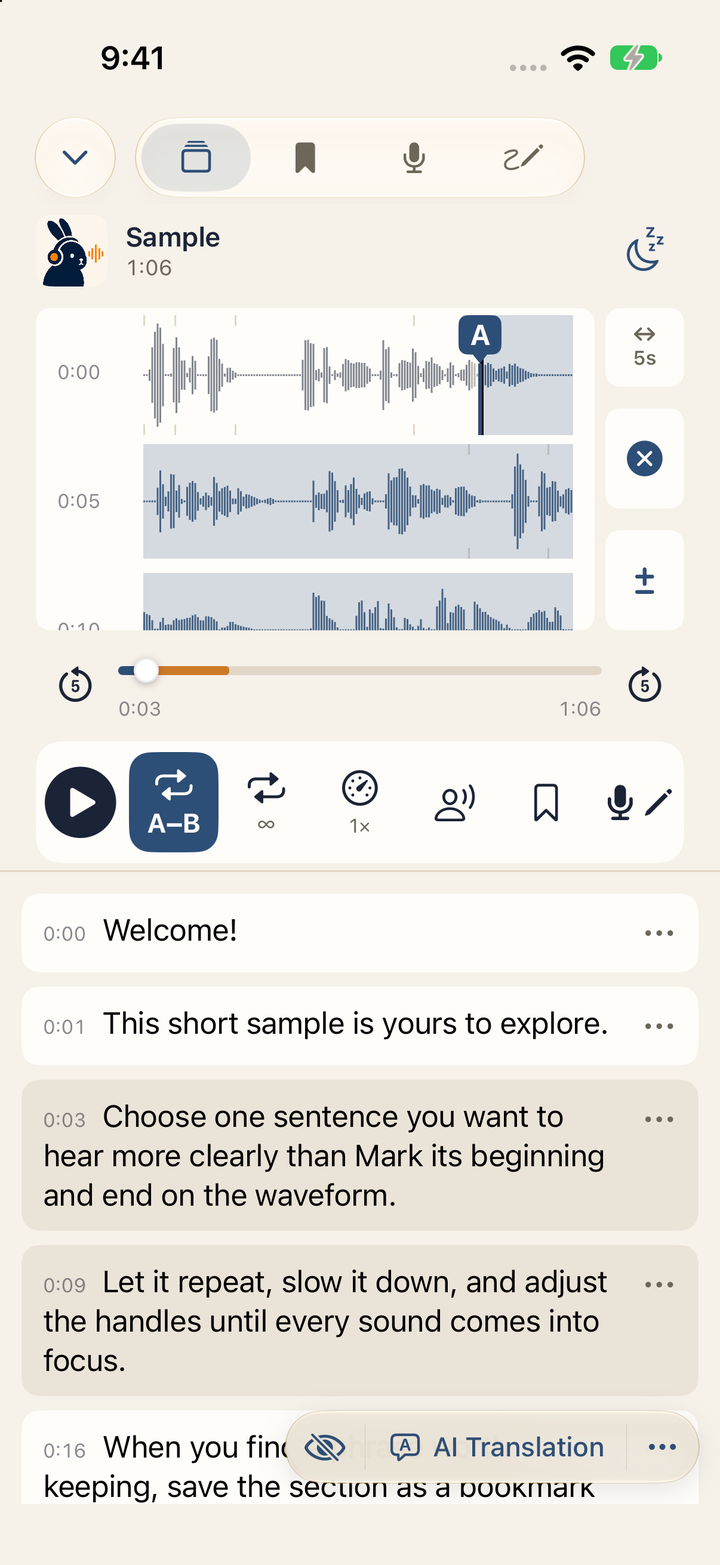 ▲ Audio player showing waveform and sentence cards on one screen
4-1. Closing and Mini Player
| Method | Description |
|---|---|
| Down arrow at top left | Closes the player and returns Home |
| Swipe down from the top | Pulls the player down by hand |
If audio is loaded when you close the player, the mini player appears at the bottom of Home. Tap the mini player to return to the full-screen player.
If a Premium user turns on Settings > Playback > Background playback, audio may continue while the screen is locked or the app is in the background. For free users, or when this setting is off, audio pauses when the app goes into the background.
4-2. Waveform Area
The waveform shows the audio over time. Its vertical playhead marks the current position, and short ticks mark subtitle sentence boundaries. Tap the waveform to seek, touch and hold to set A/B points, and drag the A/B handles to adjust them freely; they do not snap to sentence ticks.
- Tap the zoom tile beside the waveform to cycle through 3, 5, 8, and 10 seconds per row. Pinch the waveform for finer zoom from 2 to 15 seconds per row. A label such as 7.5s means each row spans 7.5 seconds.
- Scrolling by hand lets you inspect another part of the waveform. Current Position (◎) brings both the waveform and subtitle cards back to the playing position without seeking.
- Without subtitles, the waveform expands into the available space. On larger screens, you can also see the next row below the playing row.
4-3. Tabs and Playback Tools
The header switches between Subtitles, Bookmarks, My Recordings, and Dictation. On iPhone the tabs use icons; wider iPad layouts also show counts. In a very narrow window, use the tab menu. Tapping the audio title opens its information, and the sleep timer is beside the title.
The fixed tool row, from left to right, contains:
| Control | Action |
|---|---|
| Play / Pause | Start or pause playback |
| A-B | Set A, set B, then return to A |
| Repeat count | Choose unlimited, 1, 2, 3, 5, or 10 repeats |
| Speed | Choose 0.5×, 0.75×, 1×, 1.25×, 1.5×, or 2× |
| Shadowing gap | Leave a silent pause between repeats |
| Save bookmark | Save the current A/B range immediately |
| Practice | Open Shadowing or Dictation |
Playback speed, repeat count, and shadowing gap return to their defaults when you open a different file and stay unchanged when you reopen the same file.
The seek bar above the tools moves through the whole file; −5 / +5 skip five seconds. The waveform’s × clears the range, and ± opens fine adjustment. Range-dependent tools are dimmed until an A/B range exists.
The sleep timer stops playback after 5, 15, 30, or 60 minutes and shows the remaining time while active. Background use depends on Premium and the Background playback setting. Subtitles are created from the empty Subtitles tab; once cards exist, their floating ··· opens subtitle settings (section 7).
In a wide landscape iPad window, a full-width title bar sits above both panes, with the audio title and sleep timer. The waveform and tools occupy the left pane; the tabs sit at the top of the right pane above its lists. Portrait and narrow windows use one column.
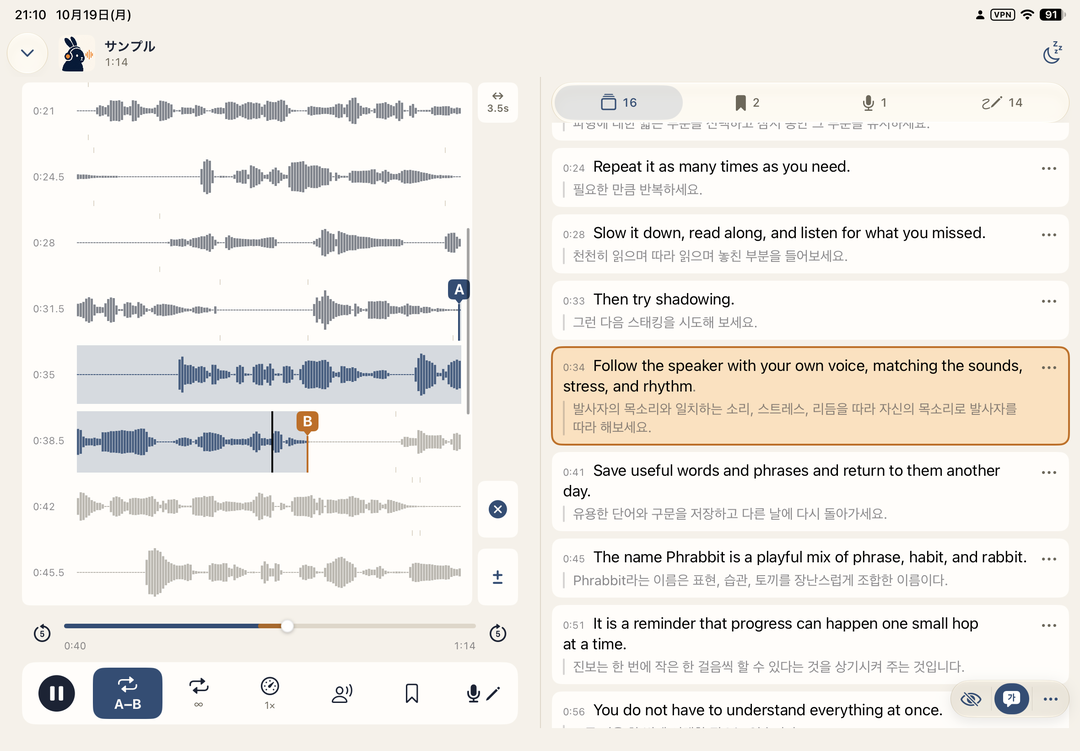
※ This iPad layout example shows English subtitles with Korean translations.
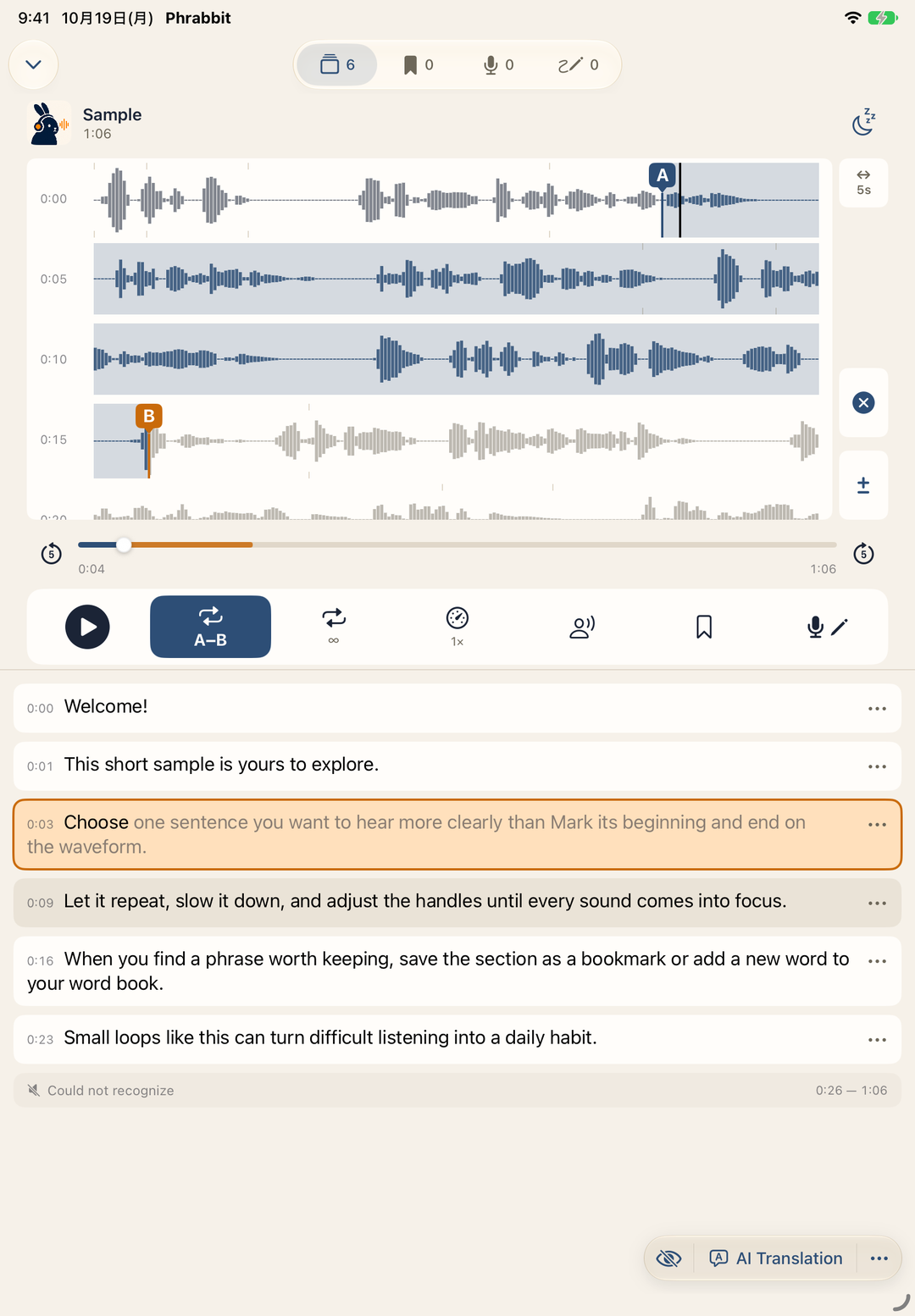
Dark appearance
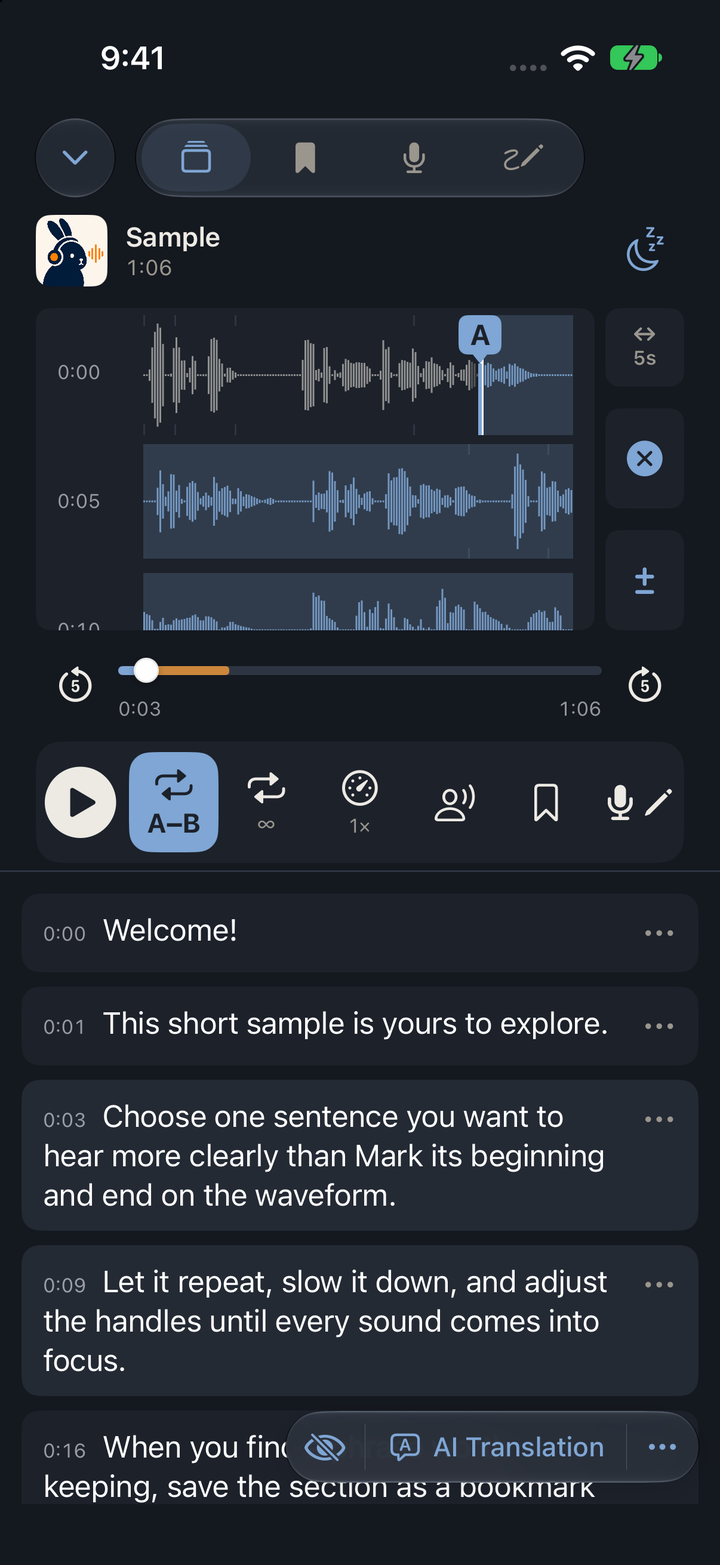
5. A/B Loop
A/B looping is the core feature for repeating one sentence or short expression until it becomes clear.
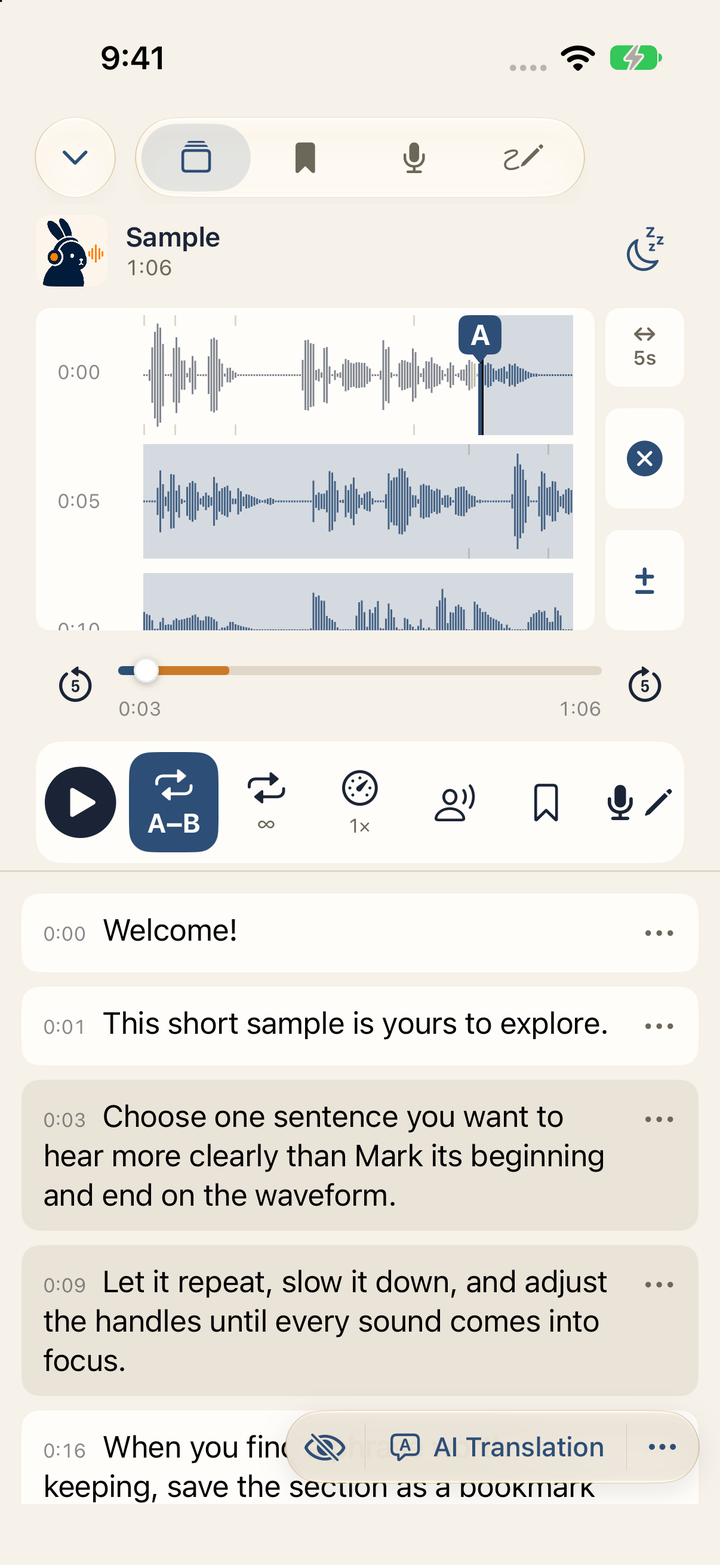 ▲ Fine-tuning an A/B range by touch
5-1. Set with the A-B Button
- At the start of the section, tap A-B. This becomes point A.
- At the end, tap A-B again. This becomes point B and looping starts.
- After a range is set, tapping A-B jumps back to point A.
The button changes by state.
| State | Meaning |
|---|---|
| A-B | No range yet |
| A→B | A is set and waiting for B |
| Filled A-B | A and B are both set and looping |
When only A is set, the hint Tap A-B again to set the end appears. If you tapped A by mistake, use the close button on the hint to cancel.
5-2. Set Precisely on the Waveform
Long-press the desired point on the waveform to set an A/B point. Drag the A and B handles with your finger to fine-tune the range.
5-3. Fine Adjustment and Clearing a Range
Use ± beside the waveform to open start/end adjustment in 0.1-second steps. Use × to clear A/B, including an unfinished A point. The same controls sit beside the time ruler on Stream and video; those players adjust in 0.5-second steps.
Open Practice from the fixed tool row to choose Shadowing or Dictation. The controls remain available while you scroll the sentence cards.
5-4. Shadowing Gap
The Shadowing gap button stays in the fixed tool row and becomes available when A/B is set. Turn it on to add a short silent gap between repeats, so you can say the sentence yourself after listening. This is a free practice mode and does not require recording.
During the silent gap, a Speak countdown is shown.
6. Bookmarks and Loop Lists
Bookmarks save A/B ranges you want to practice often.
6-1. Save a Bookmark
- Set an A/B range first.
- Tap Save in the fixed tool row.
- The range is saved immediately with an automatic name, and a Bookmark saved toast appears.
- Tap Rename in the toast if you want to name it now. You can also rename it later from the bookmark list.
Phrabbit creates the automatic name from the file title and range length. The same range is not saved twice.
6-2. Bookmark List
Open the Bookmarks tab for the current file. Tap a bookmark to restore and play its A/B range. My Recordings and Dictation have their own tabs, including when a list is empty.
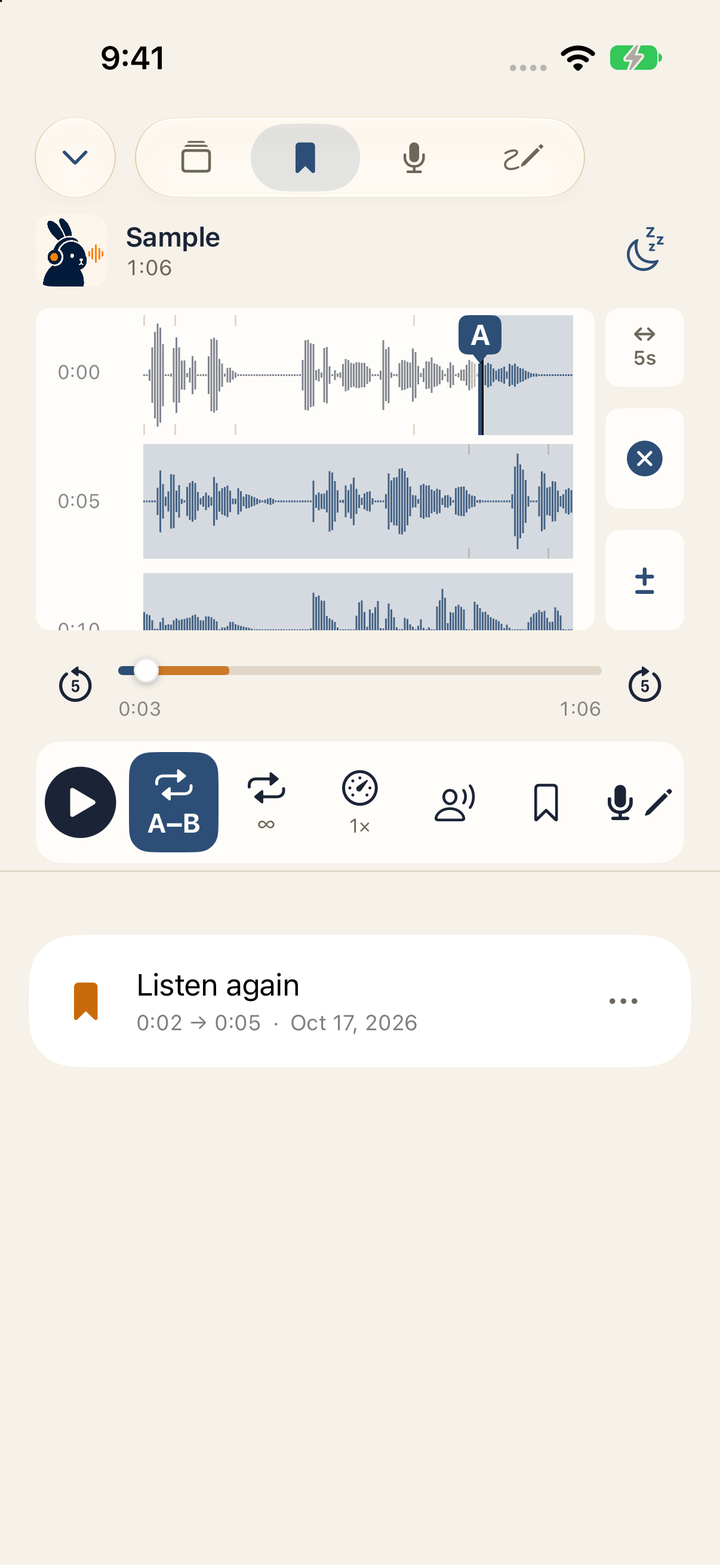 ▲ Bookmarks, recordings, and dictation each have their own tab
Use the header tabs to switch between saved bookmarks, recordings, and dictation attempts. Counts on wide iPad layouts refer to recording or attempt groups, rather than individual takes. For an audio file with at least two bookmarks, Play All plays the list in order with 1, 2, or 3 repeats per bookmark. Play All is audio-only; it is not available for video or YouTube.
Tap ⋯ at the end of a bookmark row, or touch and hold it, to show Rename, Info, and Delete. Info shows the exact A/B range, range length, and saved date. Saved recordings use the same gesture for Info or Delete; their information sheet shows the range, length, number of takes at that practice point, and recording dates. Swiping does not reveal management actions.
Free users can create up to 1 new bookmark per audio file. During Premium or the free trial, you can create unlimited bookmarks. Bookmarks saved during Premium or the free trial remain available after returning to free status, but you cannot add new bookmarks beyond the free limit. Saving bookmarks for YouTube streams is a Premium feature.
7. Speech-to-Text (STT) Subtitles
STT converts audio into sentence-level subtitles. It is available during Premium or the free trial.
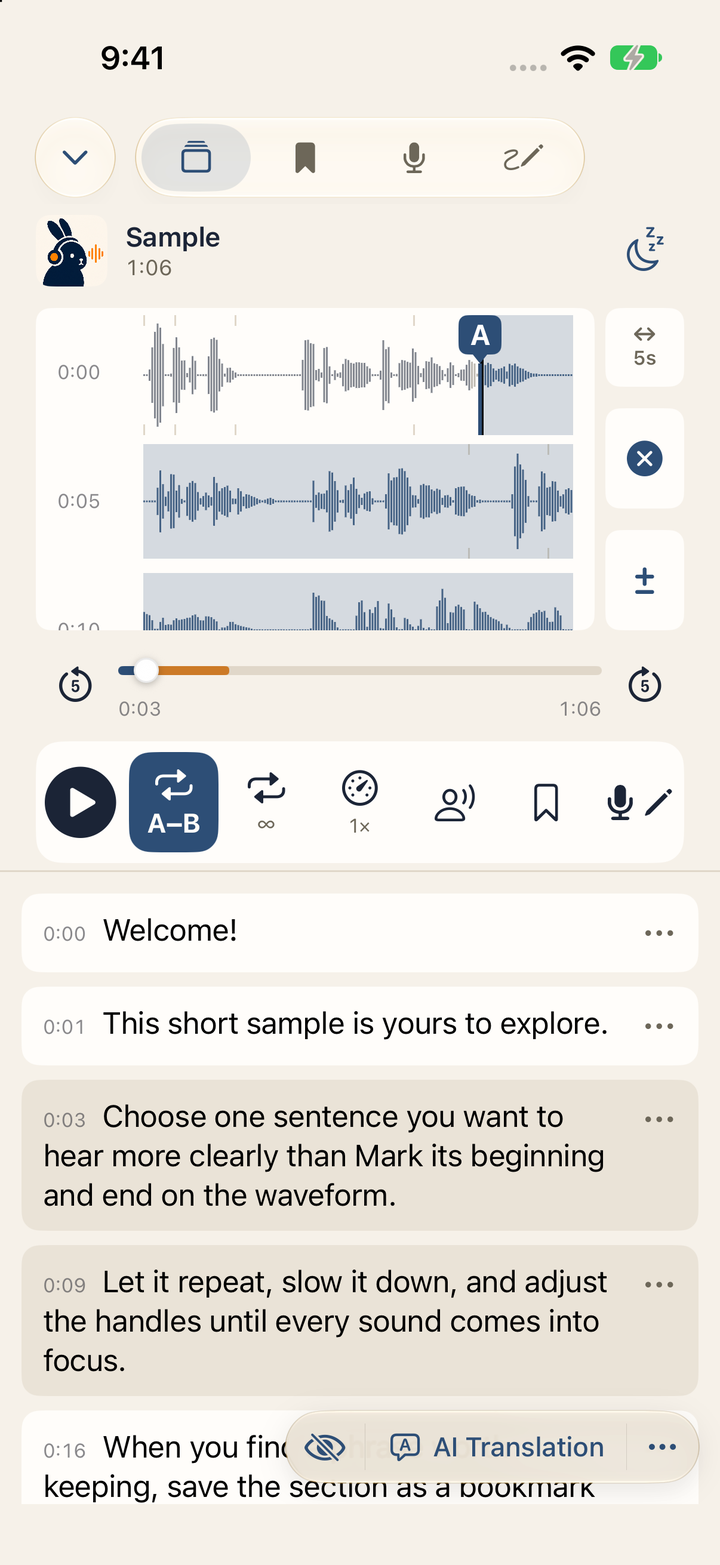 ▲ Audio converted into sentence-level subtitle cards
7-1. Start Conversion
Speech recognition requires Premium or the free trial. When access is locked, Convert speech to subtitles shows a padlock and opens the Premium screen when tapped. You can still type subtitles manually.
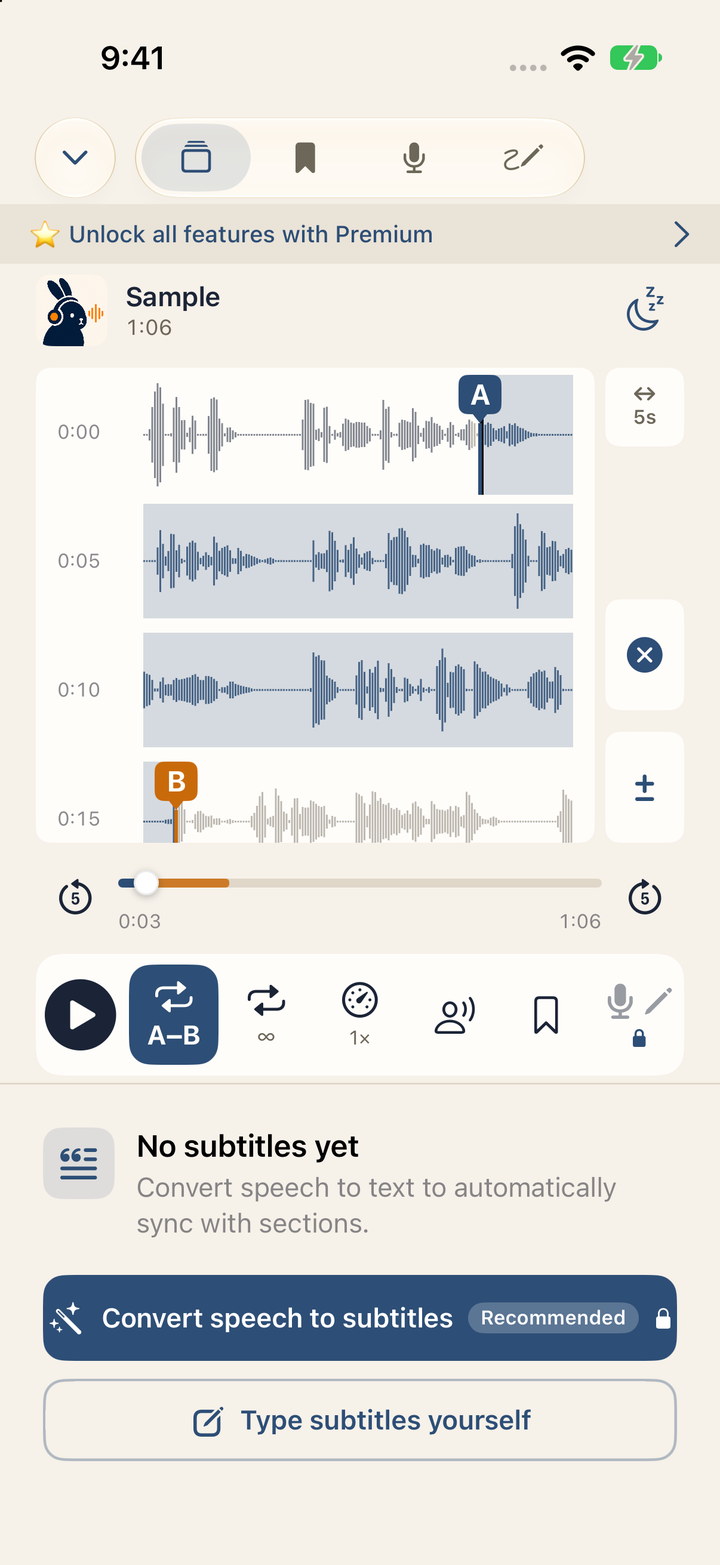
- Open the Subtitles tab. If it has no subtitles, tap Convert speech to subtitles.
- Tap the actual language spoken in the audio. The picker closes and recognition starts.
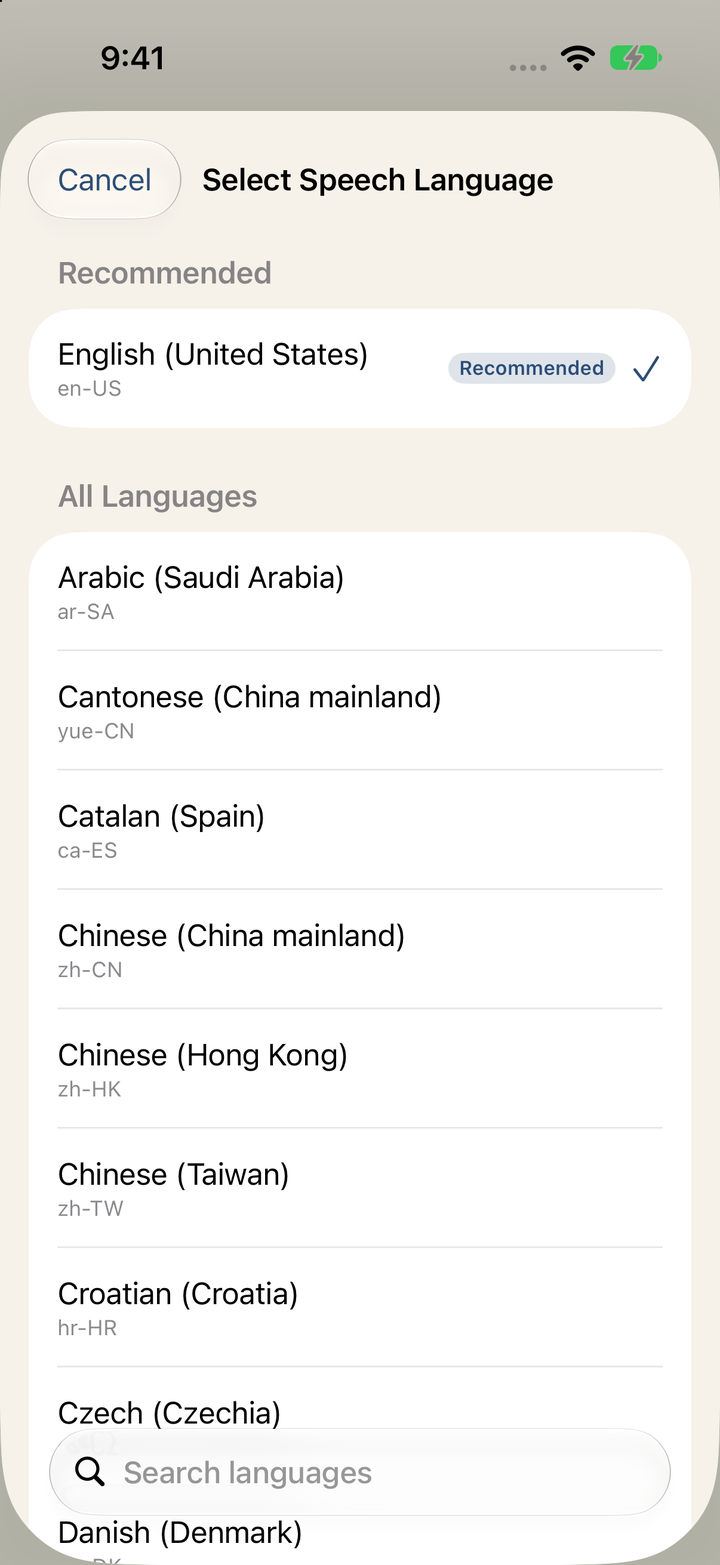 ▲ Recommended and recently used recognition languages
Language suggestions use the file’s previous selection, podcast RSS language, title, and device language. Check the suggestion against what you hear.
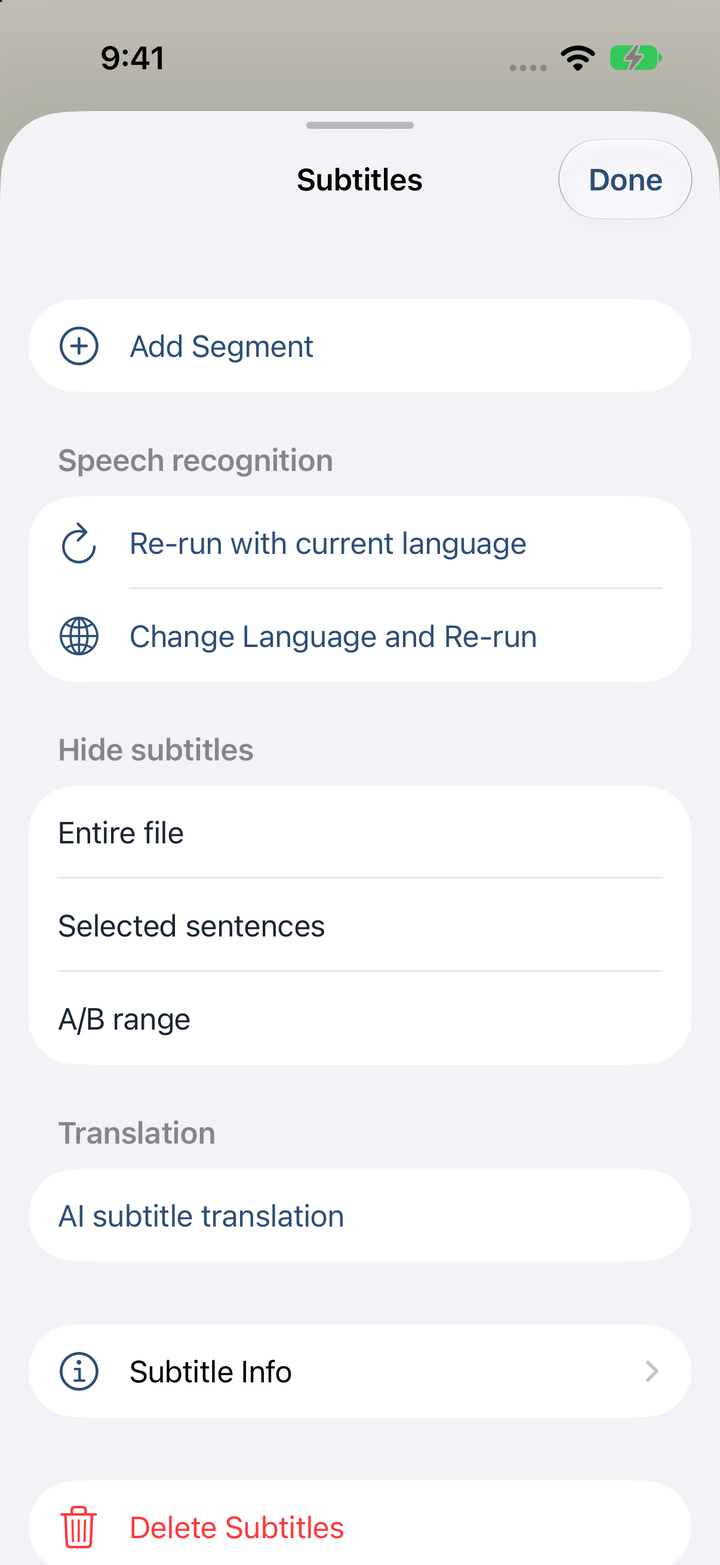
When subtitles already exist, tap the floating ··· to open the Subtitles settings sheet:
- Add Segment — type a new subtitle yourself.
- Re-run with current language — repeat speech recognition.
- Change Language and Re-run — choose a different recognition language.
- Subtitle Info — inspect recognition details.
- Delete Subtitles — delete unedited, automatically recognized subtitles, including sentences with adjusted timing. Manually added or text-edited subtitles and podcast creator transcripts remain.
Re-running preserves creator transcripts and manually edited phrases. Deletion asks for confirmation.
Re-running speech recognition and deleting its subtitles require Premium; reading saved subtitles and typing a new segment do not.
The Subtitles settings sheet opens at full height. Scroll to reach more options; you can drag it down to half height if you prefer.
7-2. During Conversion
During conversion, a Converting… or Downloading language model… progress bar appears. Some languages may need to download an on-device speech model the first time you use them.
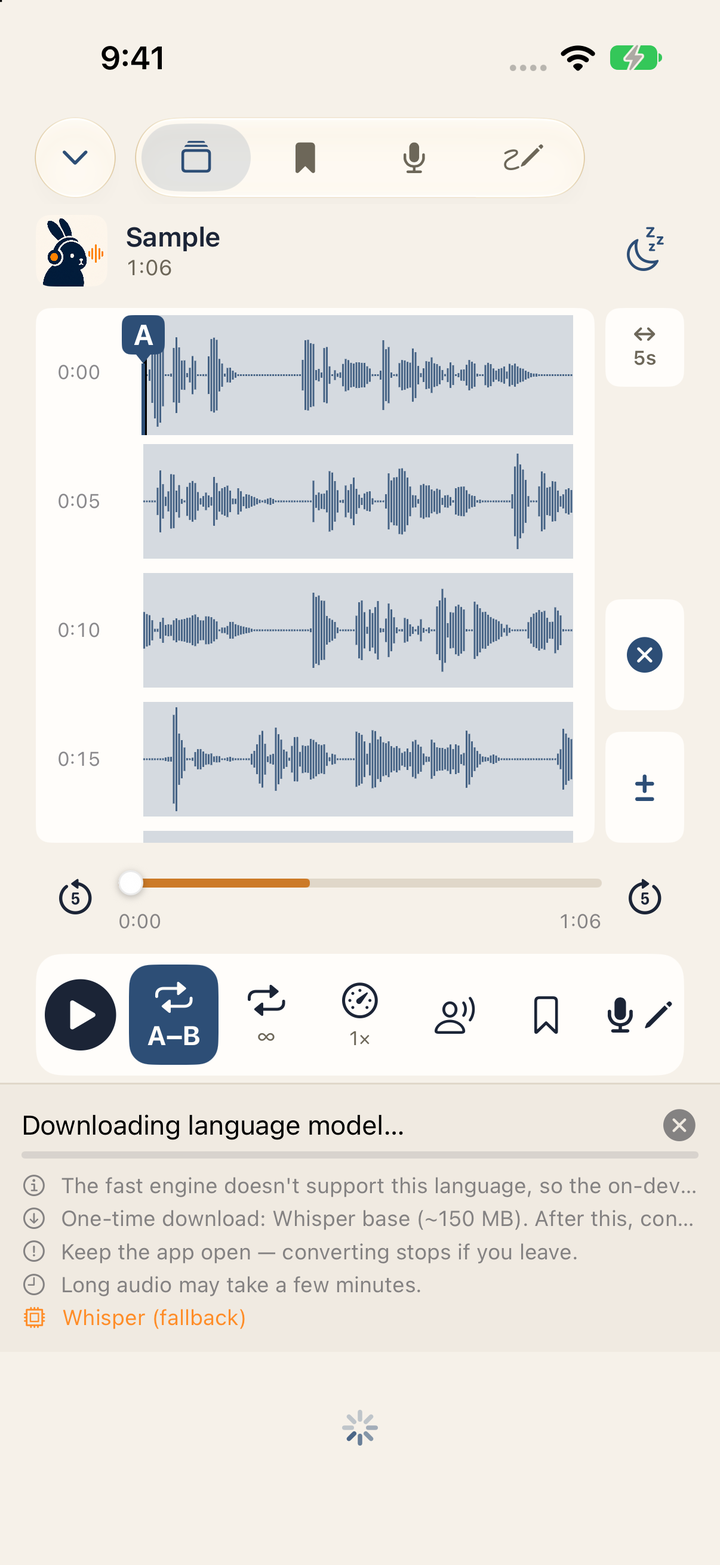 ▲ Progress and guidance are shown while conversion runs
Important:
- Keep the app open during conversion. Leaving the app or locking the screen may interrupt it.
- Long audio can take several minutes.
- If you cancel, this conversion stops and existing subtitles are kept.
- Model downloads and some recovery steps are affected by your Wi-Fi settings.
- If recognition comes back empty, Trying another recognition method… appears and the app tries once more with a different method. If it still cannot create subtitles, a message asks you to check that the audio plays and that the selected language matches. If the file could not be read to the end, you are asked to download or import it again.
7-3. View Results
When conversion finishes, subtitle cards appear in chronological order.
Each card may show:
- Start time
- Subtitle source indicator
- Low-confidence warning
- Approx. position badge when the text was recognized but timing is approximate
- Subtitle text
- A ⋯ menu with Translate, Add to Wordbook, Edit, and Delete — touch and hold the card opens the same menu
Tap a subtitle card to set that card’s section as A/B and start looping it. The currently playing card is highlighted, and cards inside the A/B range use a different background color. Newly recognized subtitles that include word timing light up word by word as playback advances. Subtitles created earlier or imported from another source may not include word timing, so this effect may not appear.
Scrolling the subtitle list by hand collapses the controls at the bottom right into a single small ⋯ button. They expand automatically about two seconds after scrolling stops, or immediately when you tap ⋯. Automatic scrolling that follows playback does not collapse them.
After you finish scrolling by hand, automatic following resumes when playback reaches a subtitle card already visible on screen. Current Position (◎) returns the audio waveform and cards to the playing position immediately. Following stays paused while you select sentences to hide.
7-4. Unrecognized Sections
Silent or hard-to-recognize sections may appear as Could not recognize cards. These cards are informational. To add a subtitle for that section yourself, move the playback position there and tap Add Segment (see 8-1).
7-5. Subtitle Information
Open the floating ··· > Subtitle Info to see the conversion date, recognition engine, quality notes, and word-timing availability. Automatic recognition can be wrong; check and edit important expressions.
7-6. Hide Subtitles
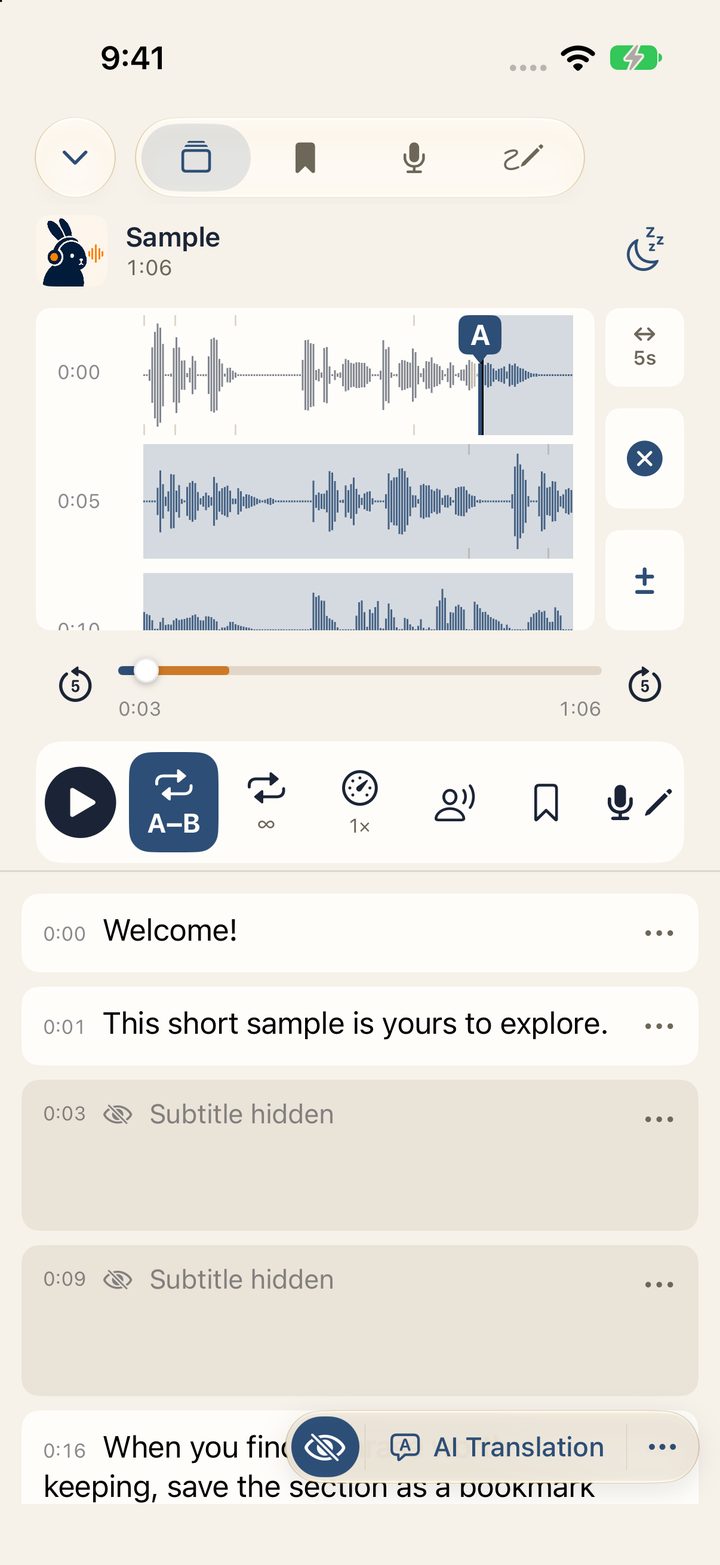
Tap the floating eye at the bottom-right of the subtitle cards to hide or show their text. Hidden cards retain their start time and Subtitle hidden, and still loop when tapped. Open ··· > Hide subtitles to choose Entire file / Entire video, Selected sentences, or A/B range. For selected sentences, tap cards to check them and press Done. A/B masking follows the range as it changes.
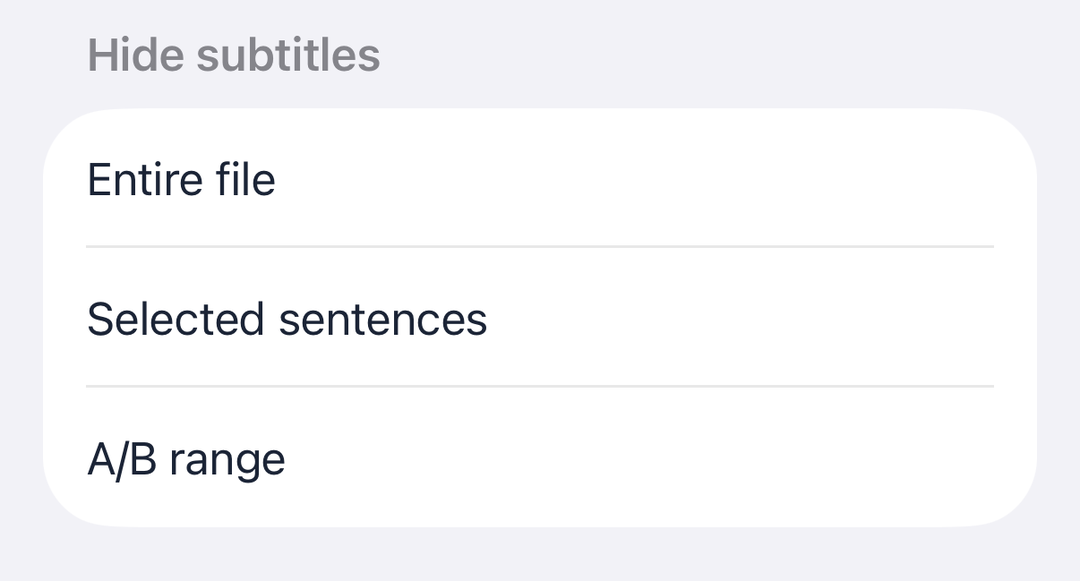
Hiding works on audio, local video, and YouTube subtitle cards. It is kept when switching tabs during the same player visit and resets when the player is closed. Use the eye to check the text after listening. Full-screen subtitle panels share the normal screen’s hiding state; choose scopes and sentences on the normal screen.
8. Editing, Translating, and Adding Subtitles
8-1. Add a Subtitle Manually
Open ··· > Add Segment in the audio Subtitles tab. Without subtitles, choose Type subtitles yourself instead. The editor starts with a 5-second segment at the current playback position. In Adjust timing at the top, drag the start and end handles on the waveform or use the buttons next to Start and End to move them 0.1 seconds at a time, and use the play button to hear only that range (see 8-2). Then type the text yourself.
To recognize the speech again, confirm the language under Recognition language and tap Recognize again. The result appears as a preview and never replaces your draft automatically. If it looks useful, tap Put in editor, make any corrections, and then tap Add at the top to save it.
8-2. Edit a Subtitle
Open a subtitle card’s ⋯ menu, or touch and hold the card, and choose Edit to open the editor. You can change the sentence’s start and end times as well as its text.
- Adjust timing - Drag the start and end handles on the waveform, or use the −/+ buttons next to Start and End to move them 0.1 seconds at a time. The buttons under the waveform show earlier or later audio and zoom in or out, and the middle button fits the view to the sentence again. The play button plays only the adjusted range.
- Adjacent sentence timing changes - If you extend a boundary into the sentence before or after, that neighbor is shortened by the overlap, and this area previews the change. If you shorten the boundary again later, the borrowed part goes back to the neighbor. A neighbor that already overlapped this sentence is left unchanged.
- Restore original range - Once you change the timing, Original range shows the original range, and this button restores it at any time. If the current boundaries of the neighboring sentences make that impossible, a message asks you to adjust the range manually.
- Restore original text - If you edit the text of an STT-generated subtitle, the original text is shown as well, and this button brings it back.
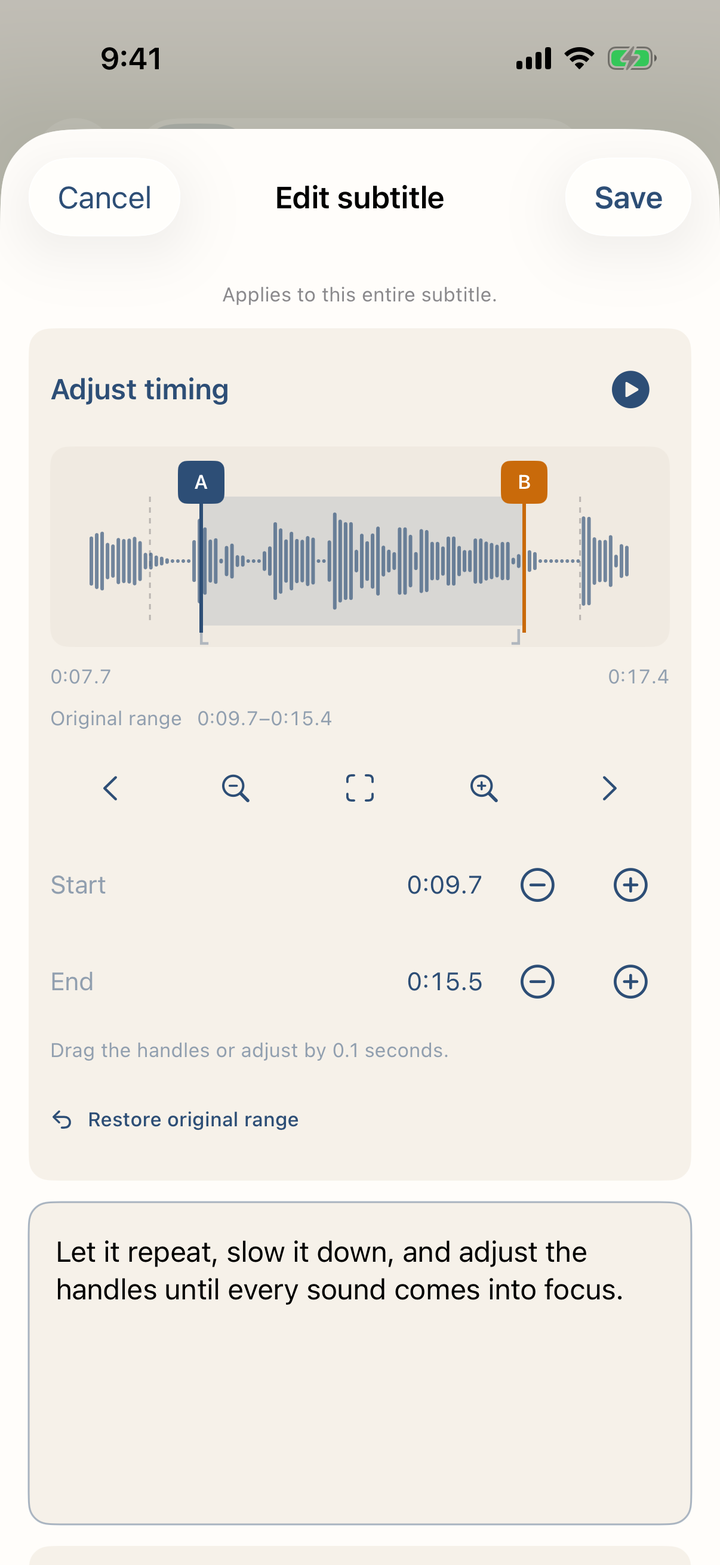 ▲ Adjust sentence timing with waveform handles, 0.1-second steps, and Restore original range.
The editor also lets you use Recognize again for only the range you have set and bring the preview into the draft with Put in editor. Neither the timing nor the text is saved until you tap Save at the top.
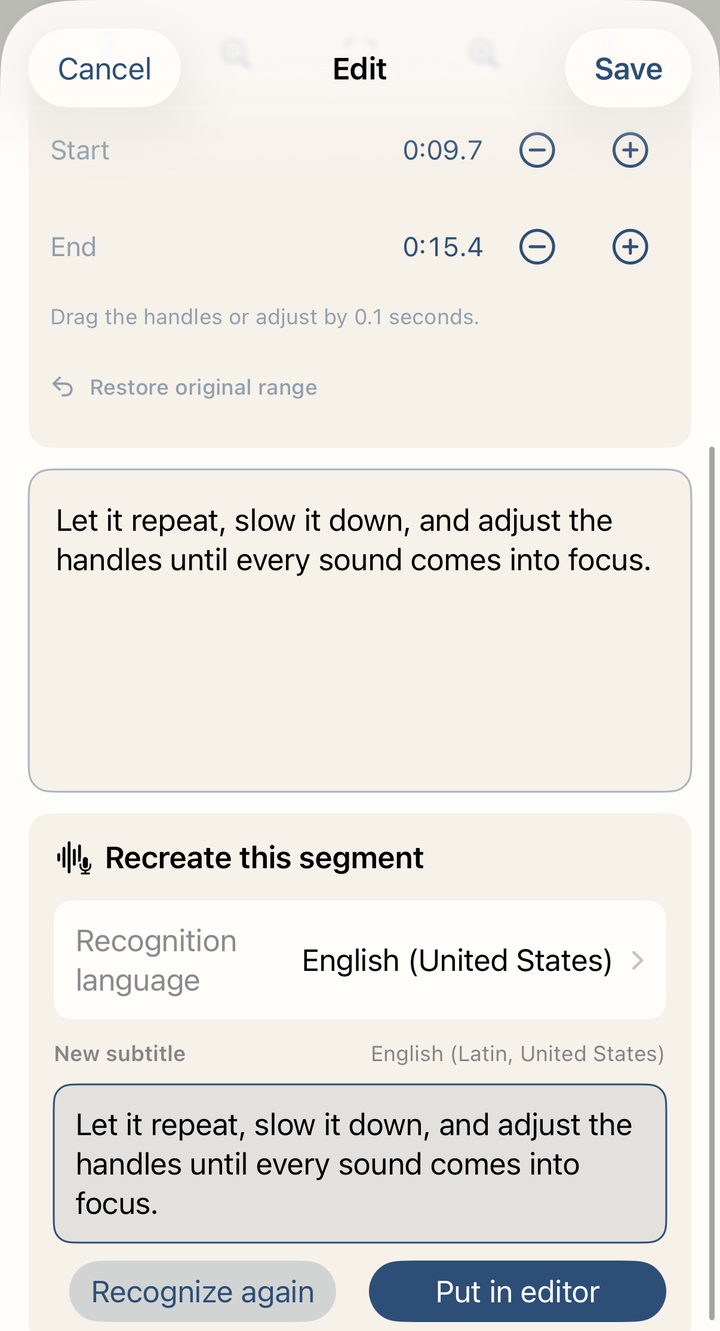 ▲ Recognition produces a preview; your draft is left alone until you insert it
8-3. Translate All Subtitles
On iOS 26.4 or later, on an Apple Intelligence-capable device, AI Translation is available from the floating translation control or ··· > Translation. Premium or the free trial is required. The subtitle language is detected automatically and shown under Subtitle language. Choose a supported target under Translation language, choose what to translate, then tap Start translation. Audio and subtitle text are not uploaded; saved results are reused when the material is reopened. The same flow supports audio, local video, and loaded YouTube captions.
Video subtitle files and YouTube captions are checked again for each sentence’s language. Sentences clearly written in a language different from Subtitle language are translated from that language, and the number of sentences and their source languages appear below Subtitle language. If most subtitles appear to be in another language, a warning is also shown; for video files, Change subtitle language to … lets you change the subtitle language directly. For video files, the Subtitle language list shows only languages this device can translate. When translation finishes, the completion message shows how many sentences were recognized as another language.
Sentences in a language this device cannot translate remain marked Not translated · language unknown, while the other sentences are translated as usual. If a translation comes back identical to the original, the sentence is tried once more; if it is still identical, only that sentence is skipped and translation finishes. If most sentences come back unchanged, translation stops and asks you to check the subtitles’ source language. Sentences translated up to that point are saved, and Retry translation also retries skipped sentences.
Progress appears while translation runs. Closing the app or player pauses the job safely, and Continue translation resumes it later. Long material can take time and warm the device; Phrabbit automatically slows the work when needed. After the job starts, an option can keep the screen awake for that run.
The speech-bubble button toggles Original only and Original + translation. In ··· > Translation, explicitly choose Translation only, change language, continue or retry, or delete saved AI translation. For bilingual video files, file translation and AI translation are separate sources (11-4).
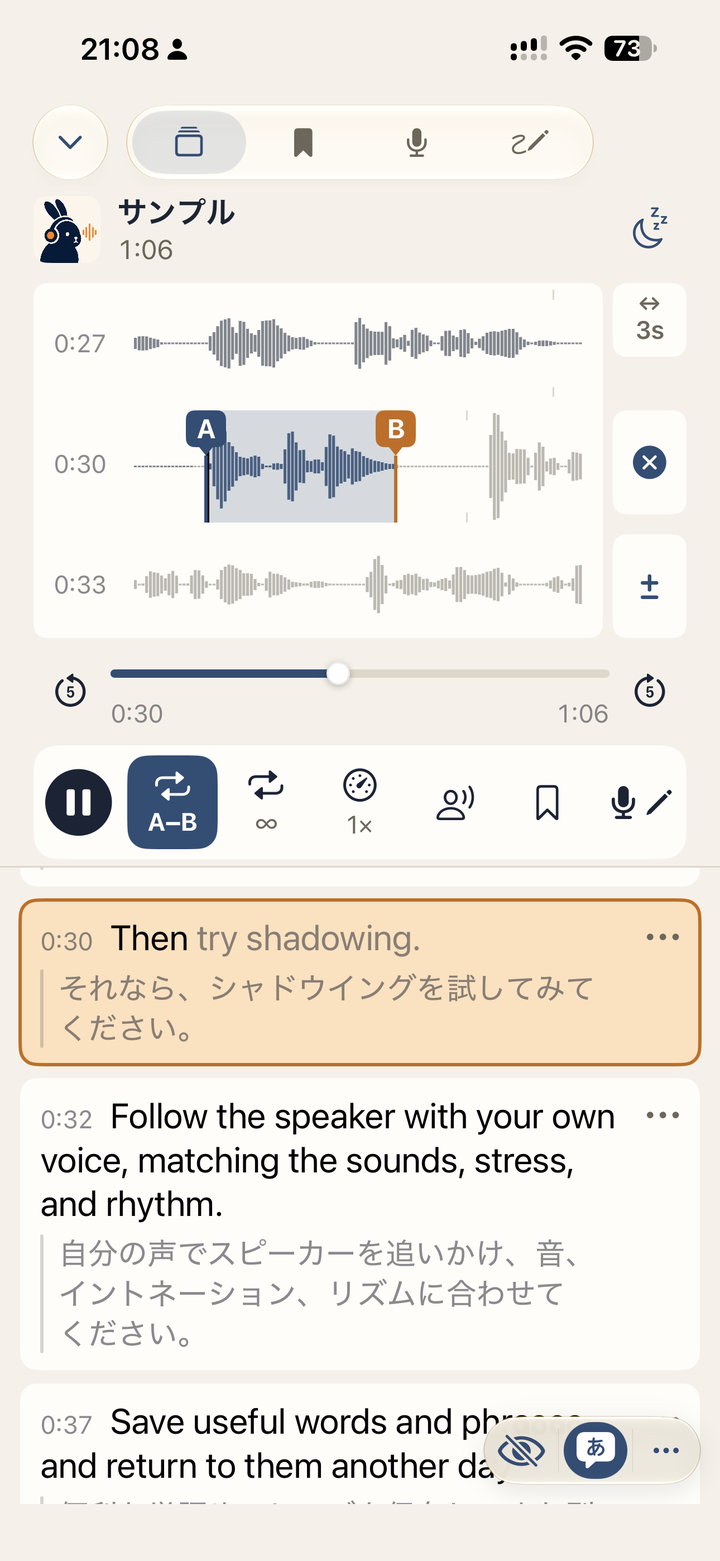
※ Example: translating English subtitles into Japanese. Choose your preferred target language in AI Translation from the supported languages.
If translation cannot start, an AI translation unavailable alert explains the current reason instead of opening the configuration sheet—for example, Apple Intelligence is off, its model is not ready, or the subtitle language is unknown or unsupported. Resolve that reason and try again. Unsupported devices and iOS versions hide the AI entry point. Machine translation can mishandle names, cultural expressions, and specialist terms, so compare important material with the original.
8-4. Translate One Sentence
Choose Translate from a subtitle card’s ⋯ menu to open the iOS system translation sheet. Translation is a study aid and may be inaccurate depending on context.
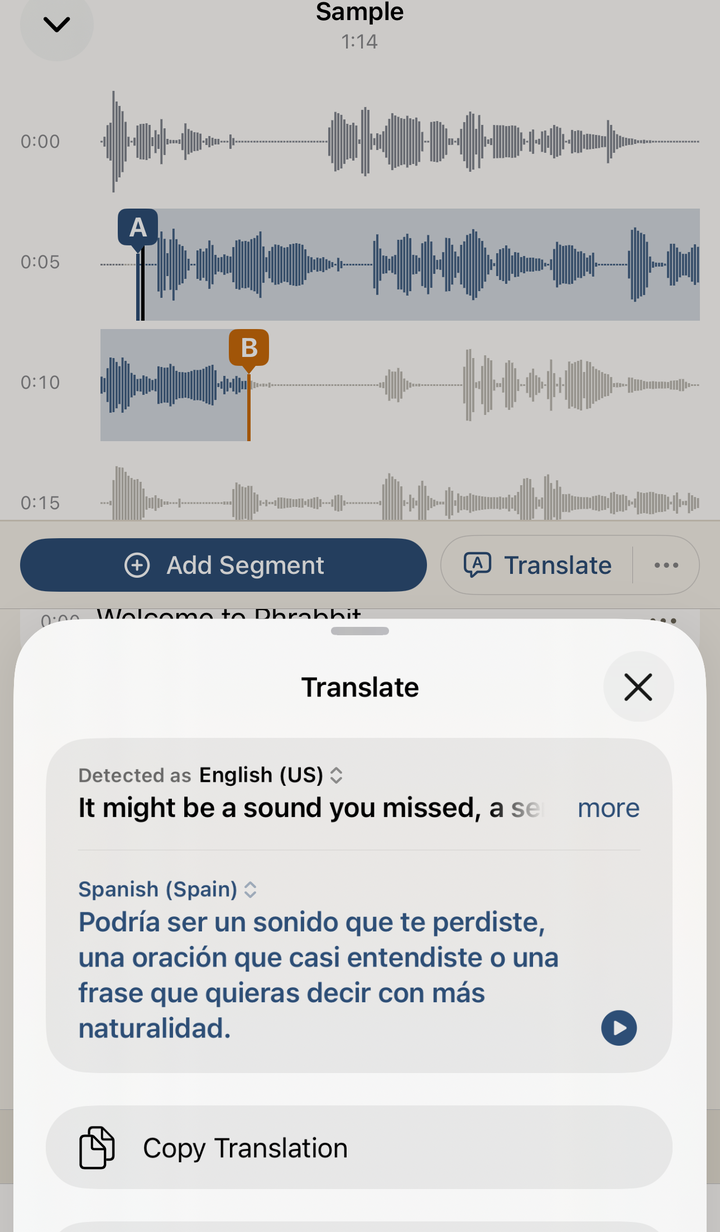 ▲ Translating a subtitle sentence in place
On video and YouTube cards, this action is named Translate this sentence. It translates one sentence in the system sheet; AI Translation saves a translation for the material.
8-5. Add to Wordbook
Choose Add to Wordbook from a subtitle card’s ⋯ menu to pick a word or expression from that sentence and save it. The Wordbook itself is a Premium feature, so if the free trial has ended, this opens the Premium screen.
9. Wordbook
The Wordbook collects words and expressions saved from subtitle cards. It is available during Premium or the free trial.
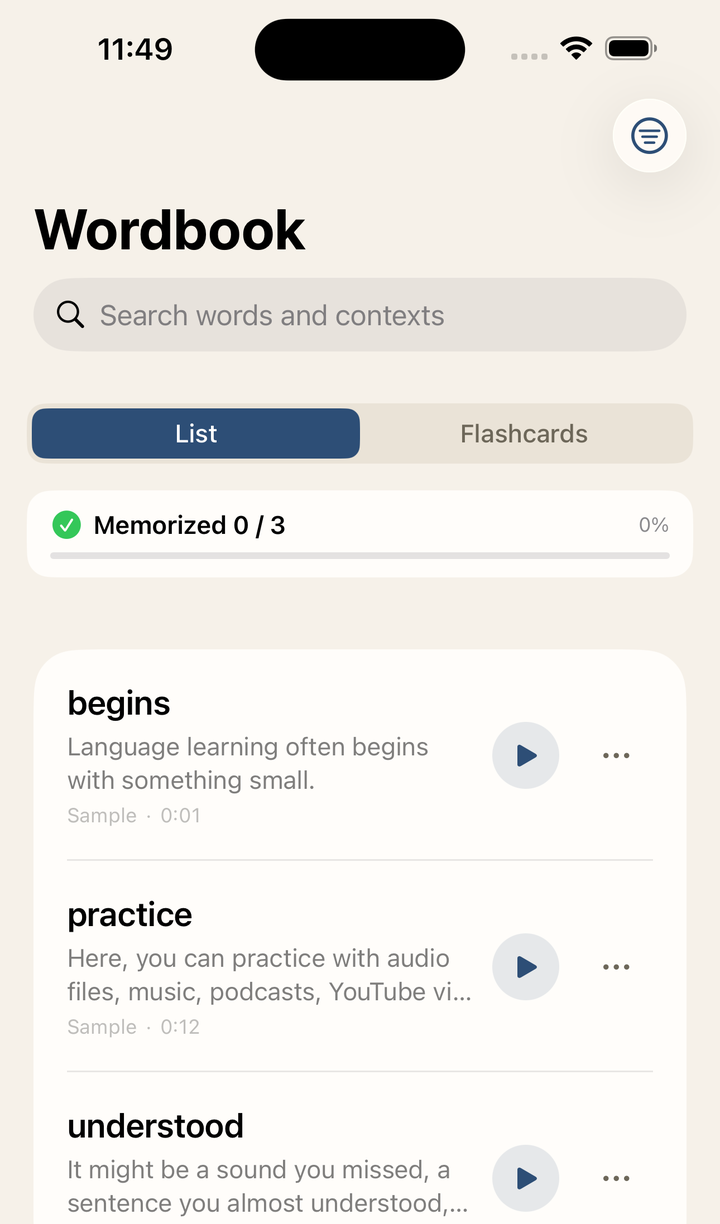 ▲ Wordbook entries saved together with context
9-1. Save a Word
Choose Add to Wordbook from a subtitle card’s ⋯ menu.
You can save:
- Word or expression
- Meaning
- Study context
- Context translation
- Memo
- Apple Intelligence explanation
Choose one of the automatically extracted word chips, or type directly into Custom Input. For languages with spaces, the app shows word-level chips. For Japanese and Chinese, it re-tokenizes the sentence to show more natural units.
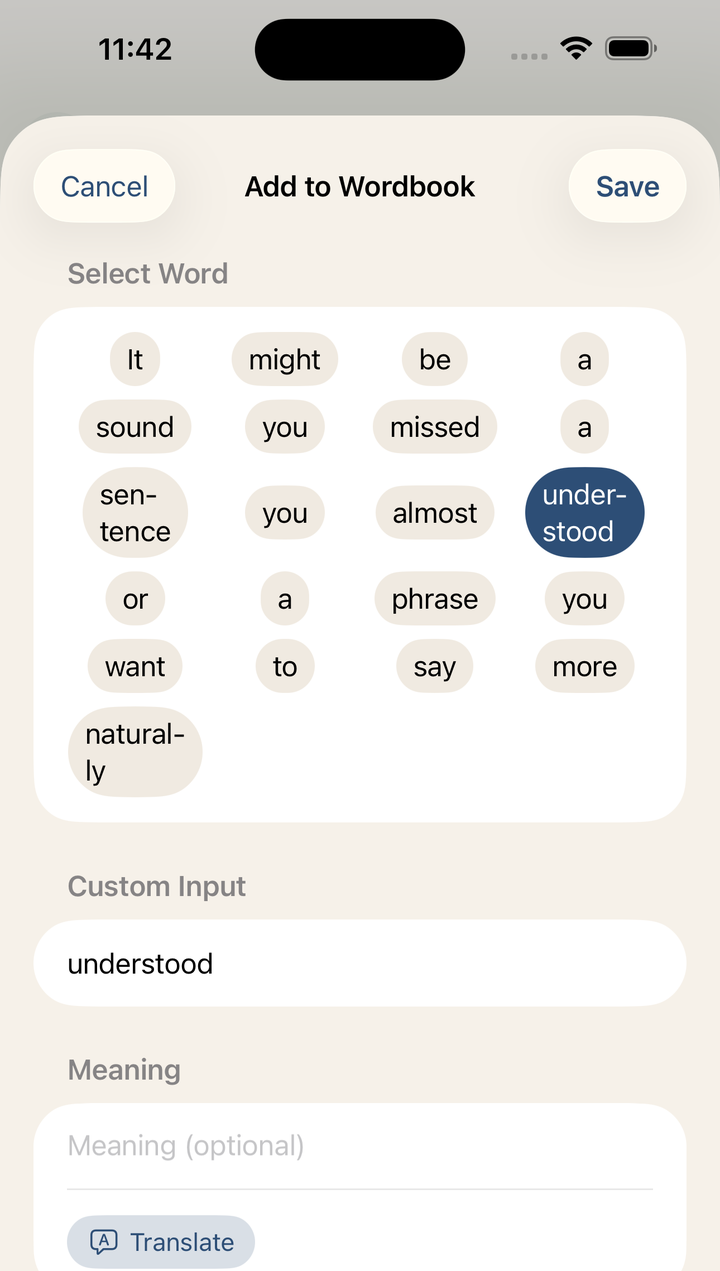 ▲ Choosing a word from a subtitle sentence and saving meaning and context
9-2. Fill with Translate
Meaning and Context Translation include a Translate button. Tap it to fill meaning or context translation with the iOS translation feature. You can edit the result before saving.
When the audio language and device language are the same, iOS translation may not create a separate translation. In that case, type or edit the meaning and context translation manually.
9-3. Apple Intelligence Explanation
If Apple Intelligence is available, an AI Explanation section may appear. Tap Generate Explanation to create an explanation of how the selected word is used in this context.
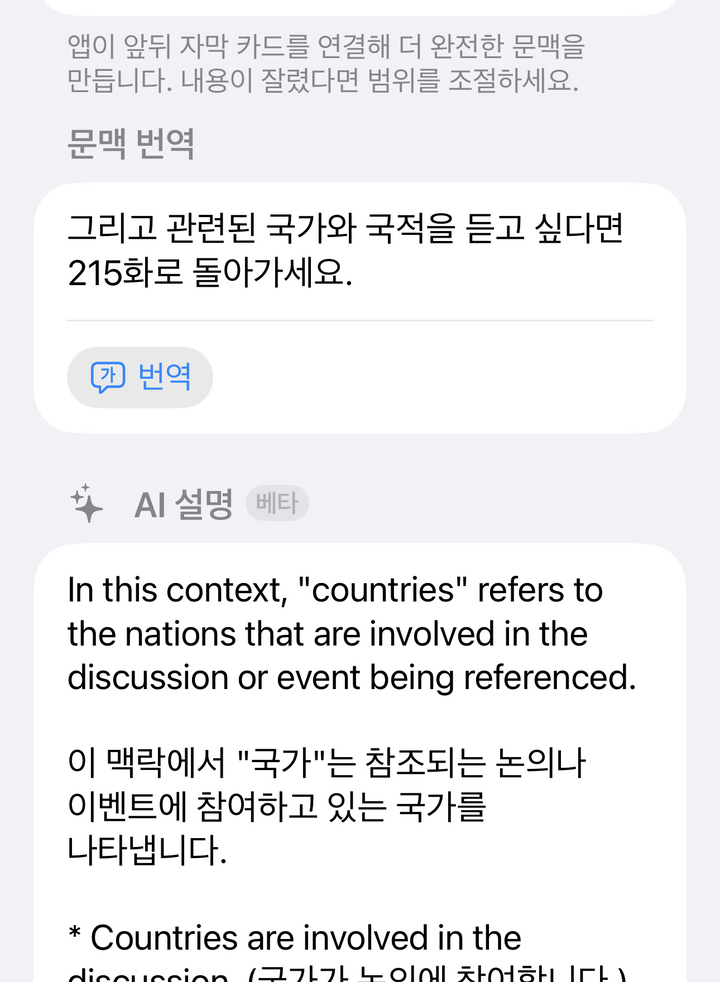 ▲ AI Explanation generated for the selected word in context
※ This screenshot uses Korean UI and Korean content to illustrate the feature. See the supported-language requirements and other conditions below.
This section appears only when all of the following are true.
- iOS 26 or later
- A device that supports Apple Intelligence
- Apple Intelligence is turned on in device settings and the model is ready
- The study language can be determined from the subtitle language, podcast language metadata, or sentence text
- Both the study language and device language are supported by the Apple Intelligence model
AI Explanation is not always hidden just because the languages are the same. However, if any condition above is not met, the section does not appear, and the Translate button follows the limitations of iOS translation. Generated content is a beta, on-device result and may be wrong. You can edit or remove it before saving.
9-4. List and Flashcards
The Wordbook tab has two modes.
| Mode | Description |
|---|---|
| List | Review words, meanings, context, source file, and playback position |
| Flashcards | Memorize by flipping cards |
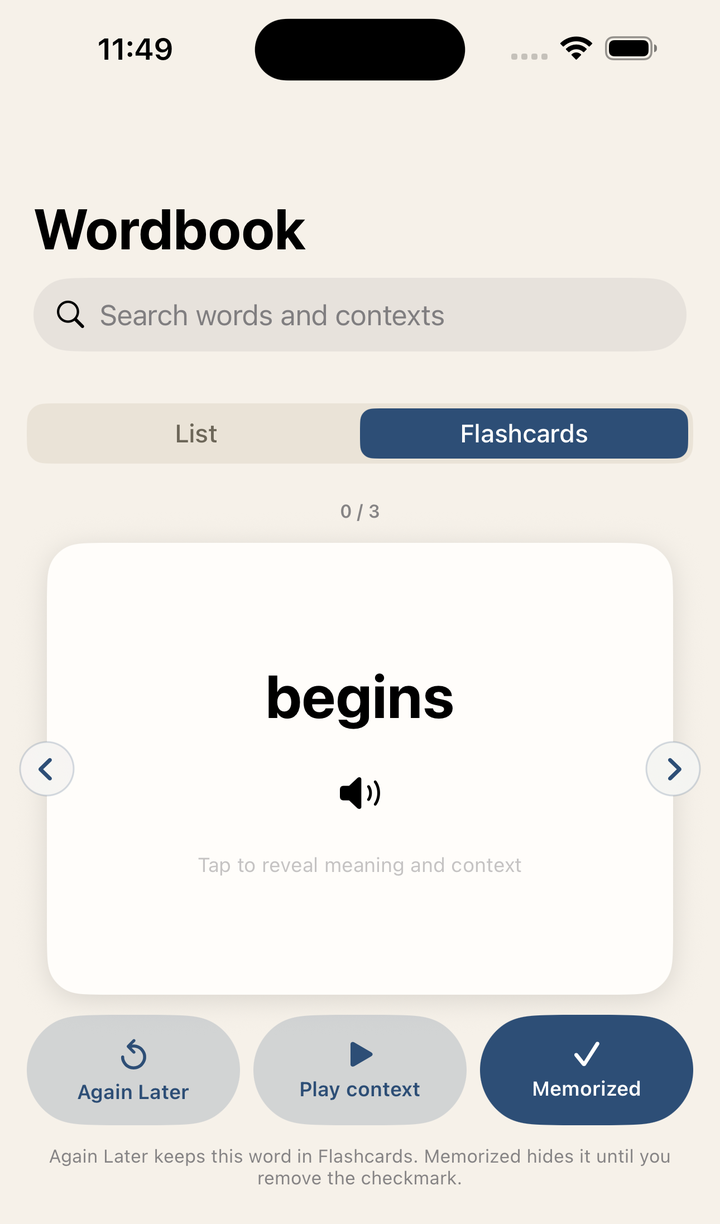 ▲ Reviewing with cards during spare moments
Use the play button in the list to hear the saved context. Tap ⋯ at the end of a row, or touch and hold it, to choose Mark as Memorized or Resume Learning, or Delete. The word detail screen shows the added date and lets you listen to pronunciation, edit meaning or memo, open the original audio, search a dictionary, and regenerate the Apple Intelligence explanation. The list can also hide memorized words.
10. YouTube Stream Practice
When you add a YouTube link, the Stream player opens. YouTube videos are not saved in the app; they play through the YouTube embedded player.
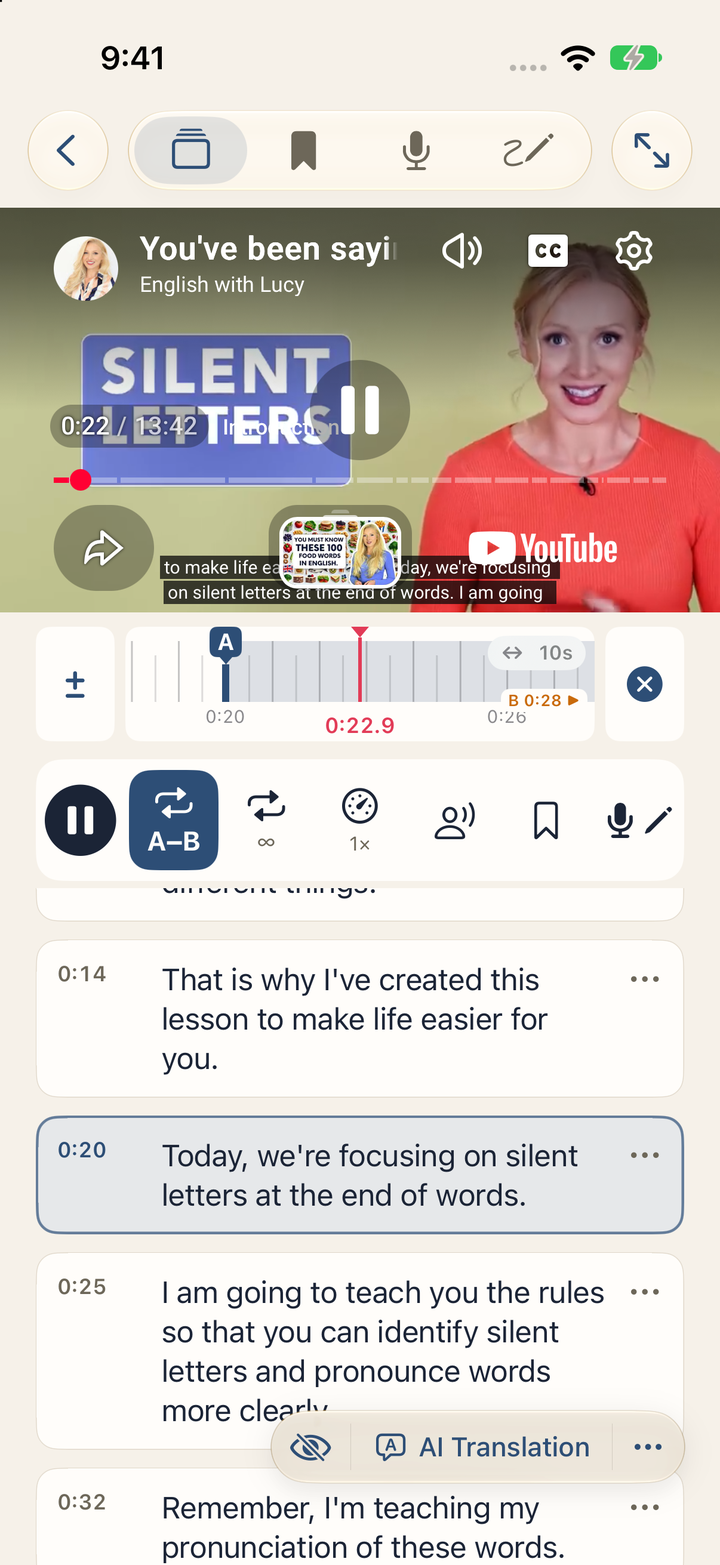 ▲ The YouTube picture, fixed tools, and subtitle cards stay on screen together.
10-1. Basic Layout
The YouTube picture stays above a fixed time ruler and a seven-control tool row: Play/Pause, A-B, repeat count, speed, shadowing gap, bookmark save, and Practice. The header switches between Subtitles / Bookmarks / My Recordings / Dictation. Only the list scrolls, so you can read cards and adjust a range together.
Tap a subtitle card to loop that sentence. Scrolling by hand pauses following; Current Subtitle (◎) returns to the current sentence. Use the floating eye, translation, and ··· controls for hiding and subtitle settings.
Scrolling the subtitle list by hand collapses the controls at the bottom right into a single small ⋯ button. They expand automatically about two seconds after scrolling stops, or immediately when you tap ⋯. Automatic scrolling that follows playback does not collapse them.
After you finish scrolling, following resumes when playback reaches a card visible on screen; you can also return immediately with ◎.
In a wide landscape iPad window, the thumbnail, title, and full-screen button share a full-width top bar. Tabs sit above the right-hand list, beside the picture and tools on the left.
10-2. YouTube Subtitle Cards
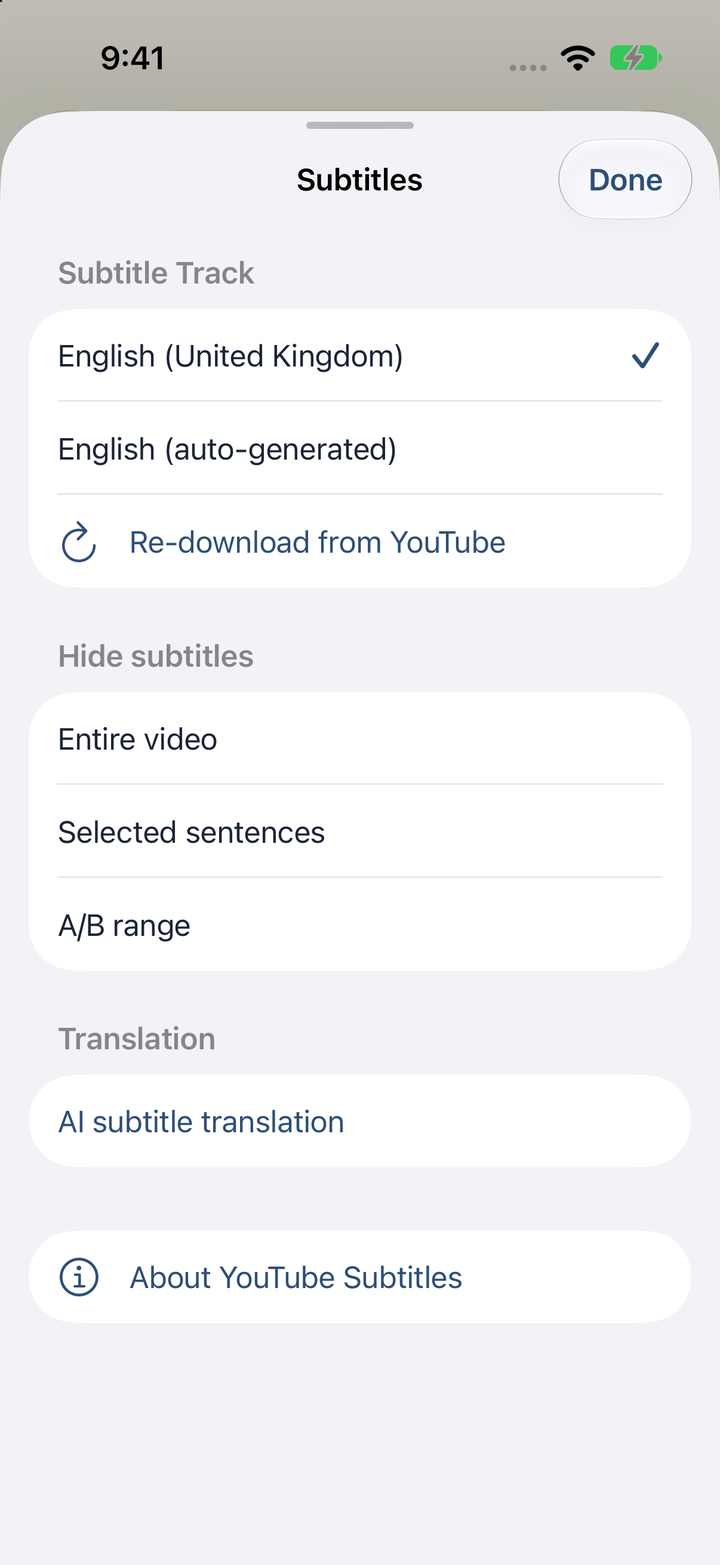
For videos that provide subtitles, Premium or the free trial can load YouTube subtitles as Phrabbit cards. Start the video once: the available tracks are reported only after playback begins. ··· > Subtitle Track changes tracks, and Re-download from YouTube fetches them again. Replacing edited subtitles asks for confirmation.
The cards support sentence looping, hiding, one-sentence system translation, on-device AI translation on supported devices, Add to Wordbook, and subtitle editing. They can also supply text for Shadowing and the answer reference for Dictation. Auto-generated YouTube subtitles may contain mistakes.
After the trial ends, stored cards remain readable and can be re-downloaded; fetching cards for a new video or choosing another track requires Premium. Without access, the Subtitles tab explains the lock and offers an upgrade. YouTube’s own CC remains available. If cards fail to load, use Try Again or the player’s CC subtitles. When YouTube sends no caption information at all, the Subtitles tab says so, and playing the video again checks once more.
For a video with no captions on YouTube, the Subtitles tab says so after you play it, and again right away the next time you open it. It takes some effort, but you can set an A/B range and tap Type a subtitle for this range to type that range’s subtitle yourself. The line becomes a subtitle card for that range, and you can keep adding lines range by range. From the second line on, setting a range shows a blank card with a dashed outline in the Subtitles list, at the place that range’s line will go; tap it to type. Typing is free. Until a range is set, the button is dimmed. A range that already has a card shows no blank card; fix the card with ⋯ > Edit instead.
To change the timing of a card you typed, tap the card so the A/B range matches it, adjust A or B, then choose ⋯ > Match the current A-B range. Remove a card you don’t need with ⋯ > Delete; the Undo shown for a moment brings it back. If YouTube captions appear for that video later and you load them, a confirmation appears before they replace the subtitles you typed.
Phrabbit does not generate STT subtitles from YouTube audio and cannot display its original waveform. These limits do not prevent using subtitles supplied by YouTube.
10-3. Full-screen Practice
Use Phrabbit’s expand button in the header to enter Full-screen Practice with A/B controls. A cards button opens a sentence panel beside the video. Tapping a card loops the sentence; the panel’s eye and translation buttons reuse the normal screen’s display state. Start translations, select hiding scopes, and edit cards from the normal screen.
Use Hide / Show to collapse or reveal Phrabbit’s full-screen controls. Taps on the YouTube picture belong to YouTube. The Exit full screen button, shown as inward-pointing diagonal arrows, remains available and returns to the normal player without stopping playback. On iPhone, Phrabbit rotates its own presentation, so rotation lock need not be disabled.
10-4. Time Ruler
Streams use a time ruler instead of an audio waveform.
- Drag - Move through the video
- Long-press - Set point A or B
- Pinch - Zoom the ruler in or out
- Adjust A/B handles - Fine-tune the range
The YouTube embedded player does not provide raw audio samples to the app, so Phrabbit uses a time ruler instead of a fake waveform.
10-5. YouTube Background Behavior
YouTube streams do not continue playing on the lock screen or in the background. When the app enters the background, Phrabbit pauses the video and remembers the position, then restores it when you return. This is a limitation of the YouTube embedded player and iOS WebKit.
11. Video Files
Phrabbit can also use video files stored on your device or in iCloud Drive as study material. Videos use the same A/B loop, shadowing, dictation, and bookmark tools as audio, with subtitles supplied by a separate subtitle file.
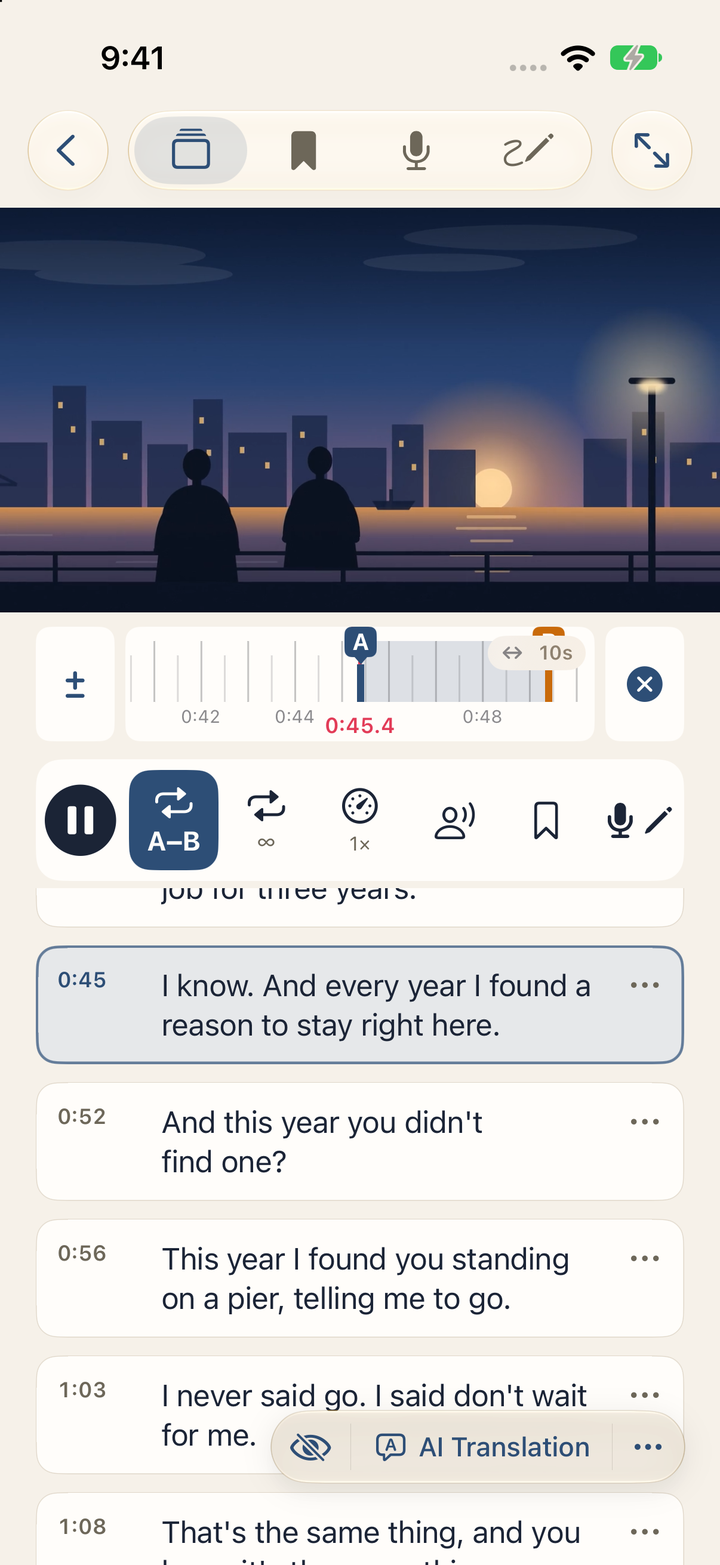 ▲ Video player showing a subtitle cue, the time ruler with A/B, and a saved bookmark
11-1. Add a Video File
Tap Add Video File in the Home plus menu and choose a video. This is a free feature.
Phrabbit supports MP4, M4V, and MOV files. Other containers such as MKV, AVI, and WebM cannot be selected in the picker.
Even inside a supported container, a file can use video or audio encoding this device cannot decode. In that case Phrabbit names the encoding it found and explains what to do. Converting the file to H.264 or HEVC video with AAC audio makes it playable.
One case looks confusing: a file that already uses HEVC but is packaged as hev1 instead of hvc1. iOS cannot play the hev1 packaging. Repackaging it as hvc1 is a fast, lossless remux and does not re-encode the video.
11-2. Videos Are Referenced, Not Copied
Unlike audio files, which Phrabbit copies into the app, a video file stays where it is. Phrabbit remembers only a link to the original file.
What this means in practice:
- Adding a video uses almost no app storage, no matter how large the file is.
- If you move, rename, or delete the original file, Phrabbit can no longer play it. The same happens when a file in iCloud Drive is removed from that account or offloaded from the device.
- When the file cannot be found, the library row shows a File missing warning, and opening the video shows a screen with Re-link File and Remove. Choose Re-link File and pick the file at its new location; bookmarks, subtitles, and playback position stay as they were.
- If the file you re-link has a noticeably different length from the original, Phrabbit warns with Different video length, because loops and subtitles may no longer line up.
The first time you play a video that is stored in iCloud Drive but not yet downloaded to this device, Preparing video… appears while the system downloads it, and a long video can take a while. Once the file is on the device it opens right away, regardless of size.
11-3. Video Player
The normal video player uses the same four tabs and seven-control tool row as Stream: Subtitles / Bookmarks / My Recordings / Dictation, with the time ruler and A/B controls fixed above the scrolling list.
- Tap the picture to play or pause. Its seek bar appears over the bottom of the picture and fades during playback; tapping the picture or operating playback shows it again.
- Use ± beside the ruler for A/B fine adjustment and × to clear the range. Practice is in the tool row.
- Subtitles appear as sentence cards below the tools. They stay visible while you adjust A/B.
- With no subtitles, the Subtitles tab offers Import subtitle file… and range speech recognition. The header’s expand button opens full-screen practice.
- In a wide landscape iPad window, a full-width bar shows the thumbnail, title, and full-screen button. The picture and controls sit on the left; the tabs head the right-hand list. Portrait and narrow windows use one column.
Videos have no waveform. Free users can create one bookmark per video; Premium or the trial removes that limit. Previously saved bookmarks remain accessible.
11-4. Subtitle Files
Import SRT, VTT, or SMI (SAMI) sidecar files. Embedded subtitle tracks inside the video are not read. With no subtitles, use Import subtitle file… in the Subtitles tab; otherwise open the floating ··· > Replace subtitle file….
The attachment preview lets you check subtitle language and sample lines before saving. For supported bilingual files, choose the original subtitle and file translation tracks, swap them, import without a translation, or keep combined text. SMI language tracks and English/Korean lines on separate lines in SRT/VTT can be separated; mixed text on one line is not split automatically. Change corrects the language used for Wordbook, pronunciation, and AI translation. Saving applies the selection; cancelling keeps existing subtitles.
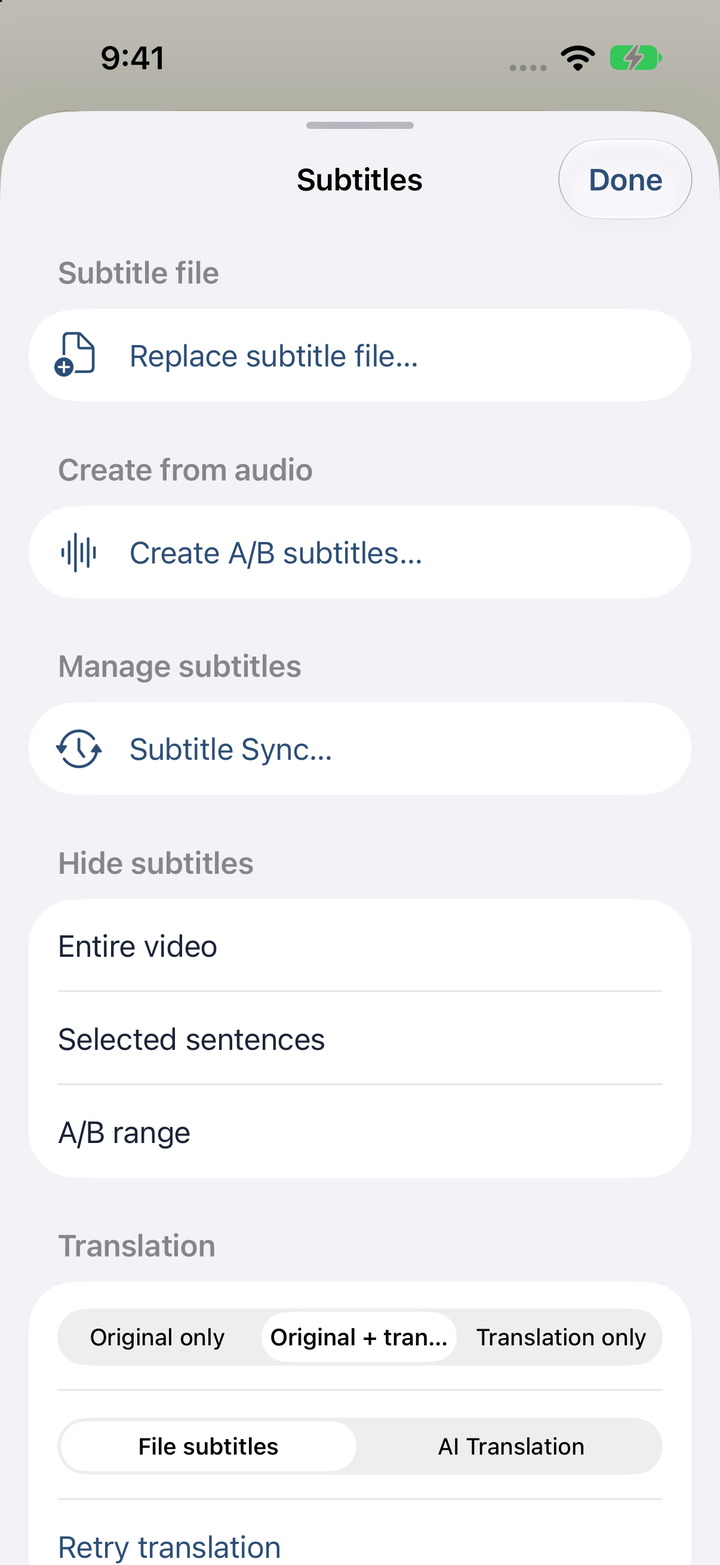
File translations can be displayed without Apple Intelligence or Premium. In ··· > Translation, choose Original only, Original + translation, or Translation only. When available, Translation source switches between File subtitles and AI Translation. Deleting AI translation does not delete the file translation. AI translation keeps its supported-device and Premium requirements.
The same settings sheet contains range subtitle generation, Subtitle Sync… (0.5-second steps), Restore Original Subtitles… when available, hiding scopes, and Delete Subtitles. Edit or add words from a card’s ⋯ menu. The normal player uses cards; the full-screen picture can also show subtitle overlays when its card panel is closed.
UTF-8 is recommended. UTF-16 with a byte-order mark and common legacy SMI encodings are also supported; if a file cannot be read, save it as UTF-8 and try again.
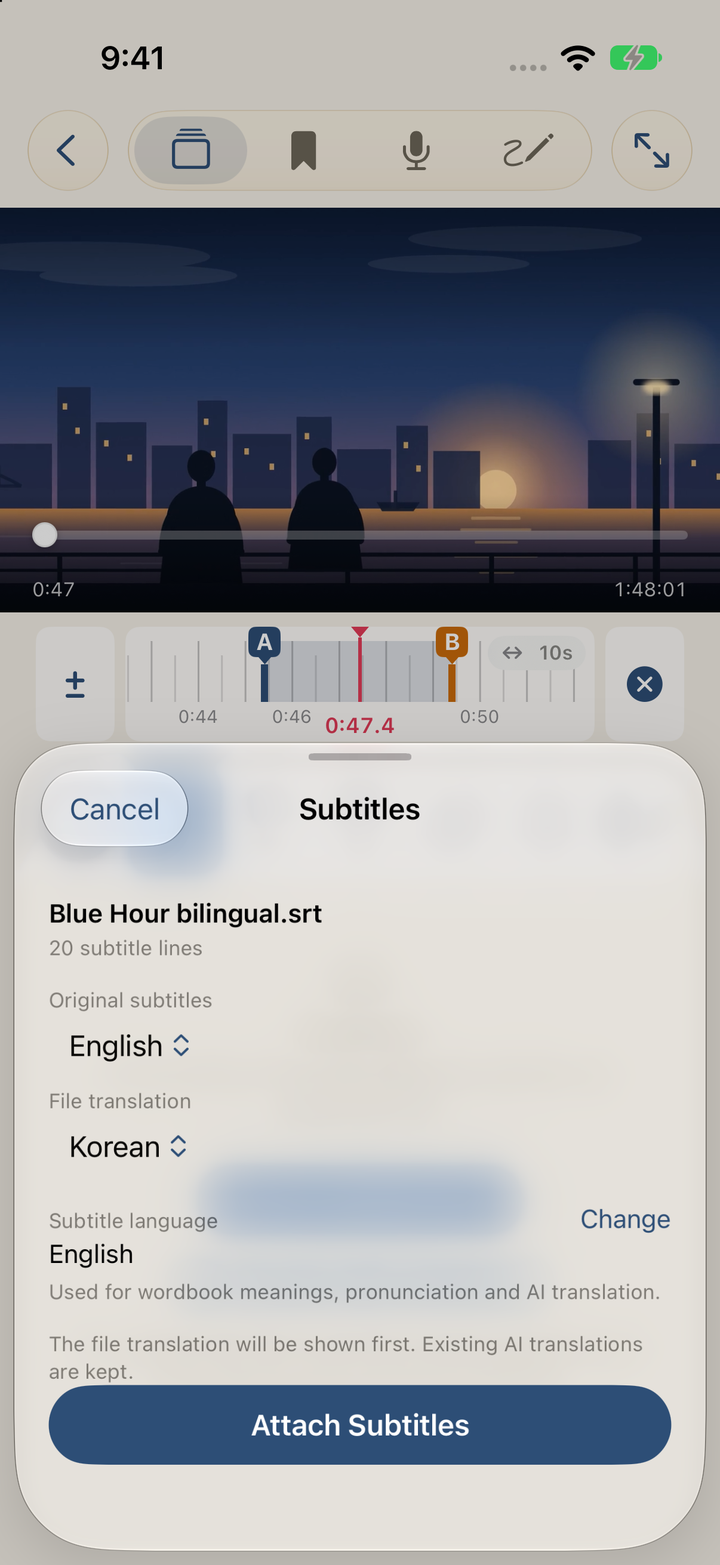
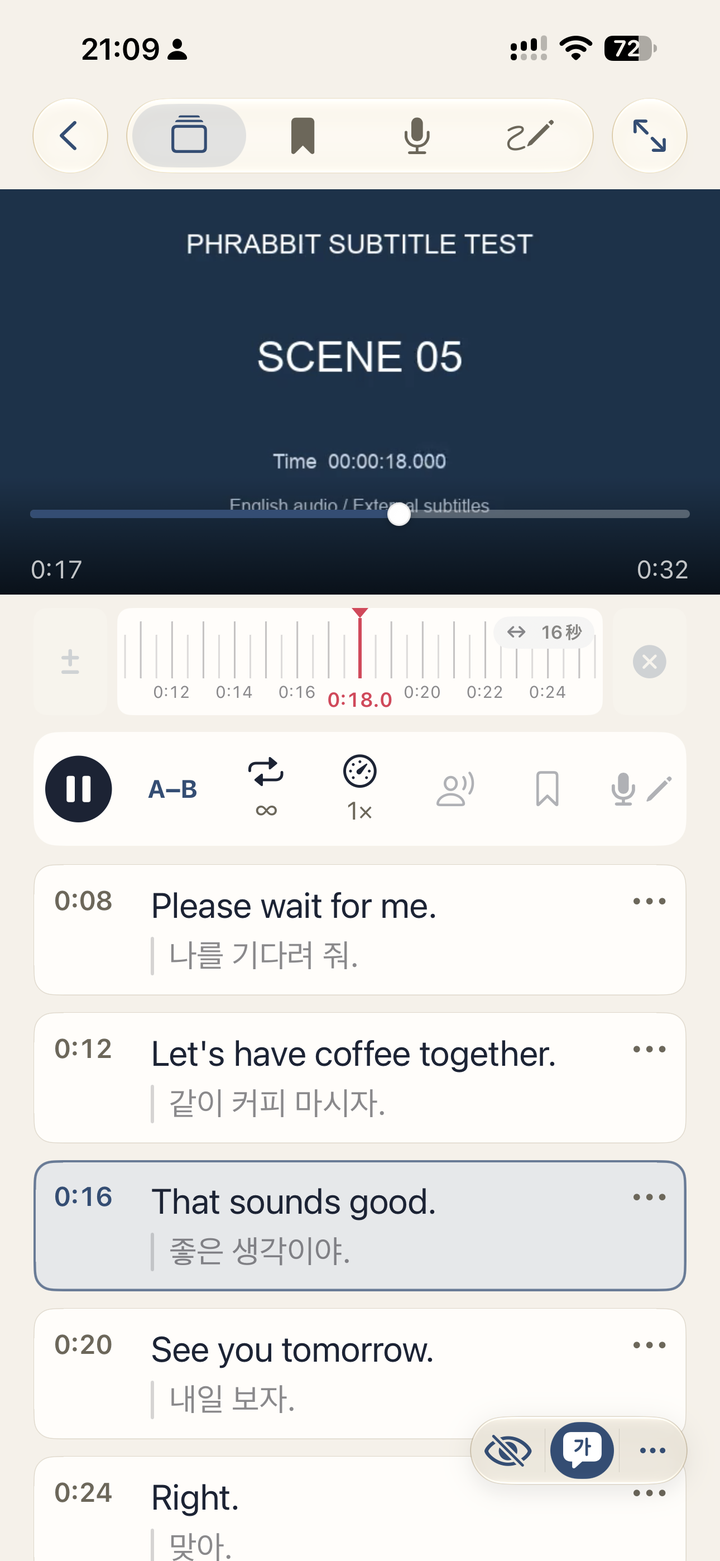 ▲ Original subtitles and the translation imported from the subtitle file, displayed together
※ This example uses English original subtitles and a Korean translation. Both tracks come from the subtitle file; the translation is not generated by AI. The languages shown depend on the file you import.
Video subtitle settings
11-5. Practice Sentence by Sentence
Each sentence card groups the subtitle lines belonging to one sentence. Tap it to set A/B and repeat that sentence; playback does not automatically advance to the next card. Subtitle sync adjustments also apply to the cards.
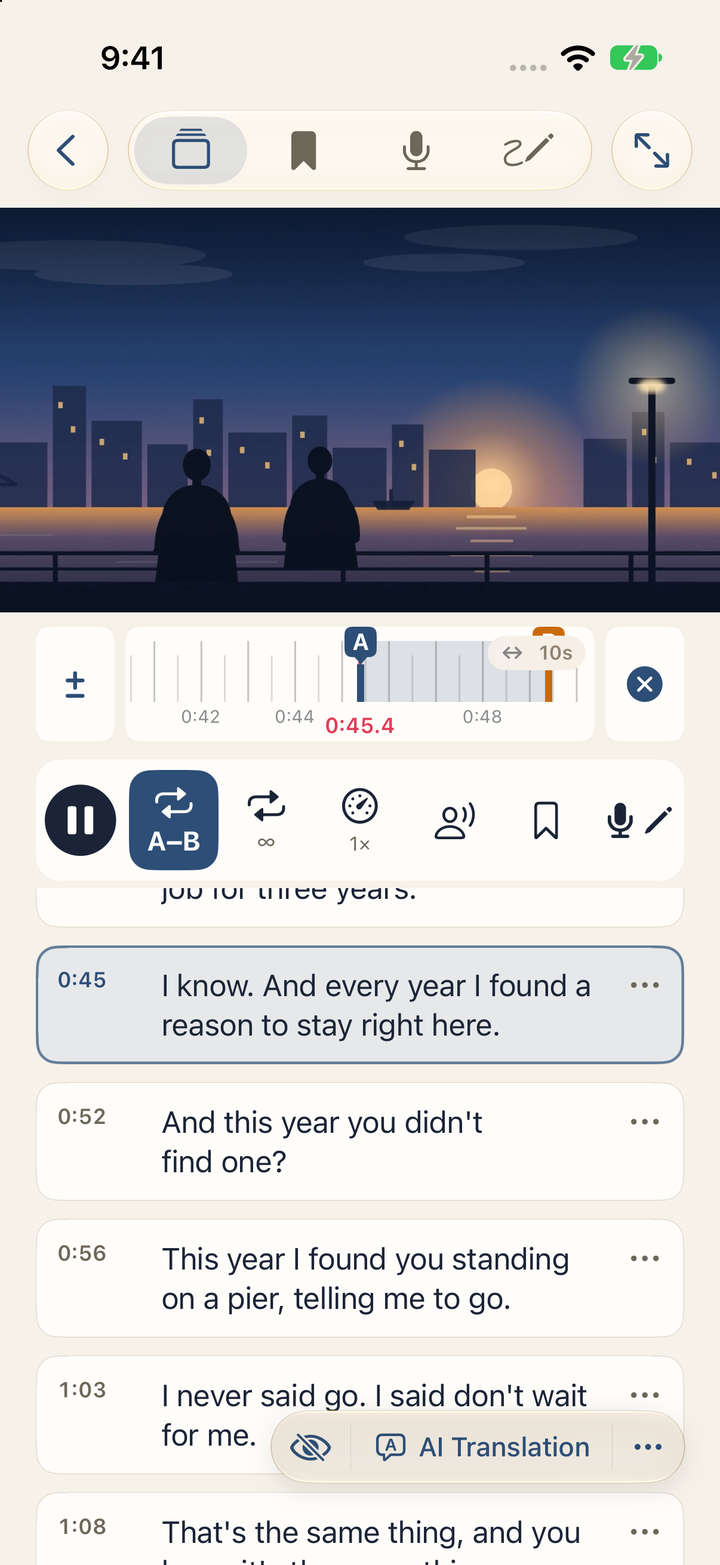 ▲ Sentence cards and the fixed practice tools stay on screen together
The current sentence is highlighted. Scroll to inspect other cards, then use Current Subtitle (◎) to return. The floating eye hides text while preserving card timing and looping; ··· chooses the whole video, selected sentences, or the A/B range. The translation button toggles Original only and Original + translation; Translation only is an explicit choice in settings.
Scrolling the subtitle list by hand collapses the controls at the bottom right into a single small ⋯ button. They expand automatically about two seconds after scrolling stops, or immediately when you tap ⋯. Automatic scrolling that follows playback does not collapse them.
After you finish scrolling, following resumes when playback reaches a card visible on screen; you can also return immediately with ◎.
11-6. Transcribe This Scene
Whole-file speech-to-text is not available for video. Instead you can transcribe only the section you are practicing. This is available during Premium or the free trial.
- Set an A/B range over the part you want.
- Open ··· in the Subtitles tab and choose range subtitle generation. With no subtitles, use the range-recognition action in the empty tab.
- Choose the language spoken in that scene.
Notes:
- A range longer than 10 minutes cannot be transcribed. Shorten the A/B range first.
- For a range longer than 3 minutes, or when the device is already warm, a Transcribe This Scene? heads-up appears first; tap Continue to go on. If the device is very hot, Phrabbit asks you to let it cool down and does not run.
- If subtitle-file lines already exist in that range, Replace Subtitles in Range? asks first. Only the lines inside the range are replaced, the originals are kept, and Restore Original Subtitles… brings them back.
11-7. Full Screen and Background
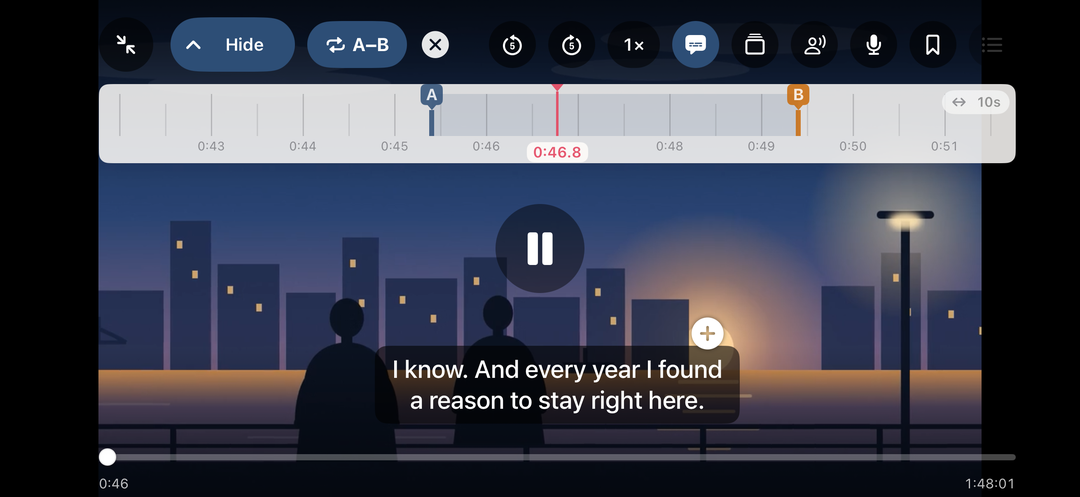 ▲ Full-screen practice keeps the A/B controls and subtitles on screen
Tap the full-screen button to enlarge the video. The screen fills sideways while the app itself stays in portrait, so you do not need to unlock device rotation. In full screen, tap the video to show or hide the controls, and use the bookmark list to jump between saved ranges.
Use the inward-pointing diagonal arrows (Exit full screen) to return to the normal player. This button remains visible when the other full-screen controls are hidden; playback continues.
The cards button opens the same sentence list beside the video in full screen. It does not cover the picture: the video, the ruler, and the seek bar move over to make room, and go back to full width when you close the panel.
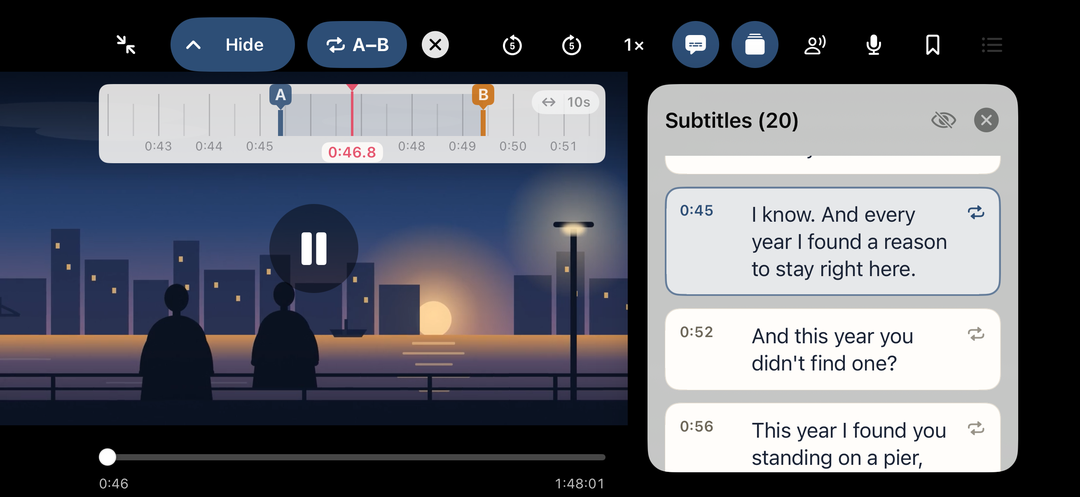 ▲ In full screen the cards sit beside the video instead of covering it
Video does not play in the background or on the lock screen. When the app goes to the background or the screen locks, playback stops. Background playback applies to audio files only.
11-8. Rename, Info, and Delete
A video title starts as the file name. Tap ⋯ at the end of its library row, or touch and hold the row, then choose Rename to change it. Info shows the full title, item type, duration, added date, and folder location.
Choose Delete from the same menu to remove Phrabbit’s record along with its subtitles, bookmarks, saved shadowing recordings, and dictation attempts. The original video file is never deleted. If saved recordings exist, a confirmation appears first.
12. Shadowing Recording and Comparison
Shadowing lets you listen to an A/B range, say it yourself, and compare your recording with the original.
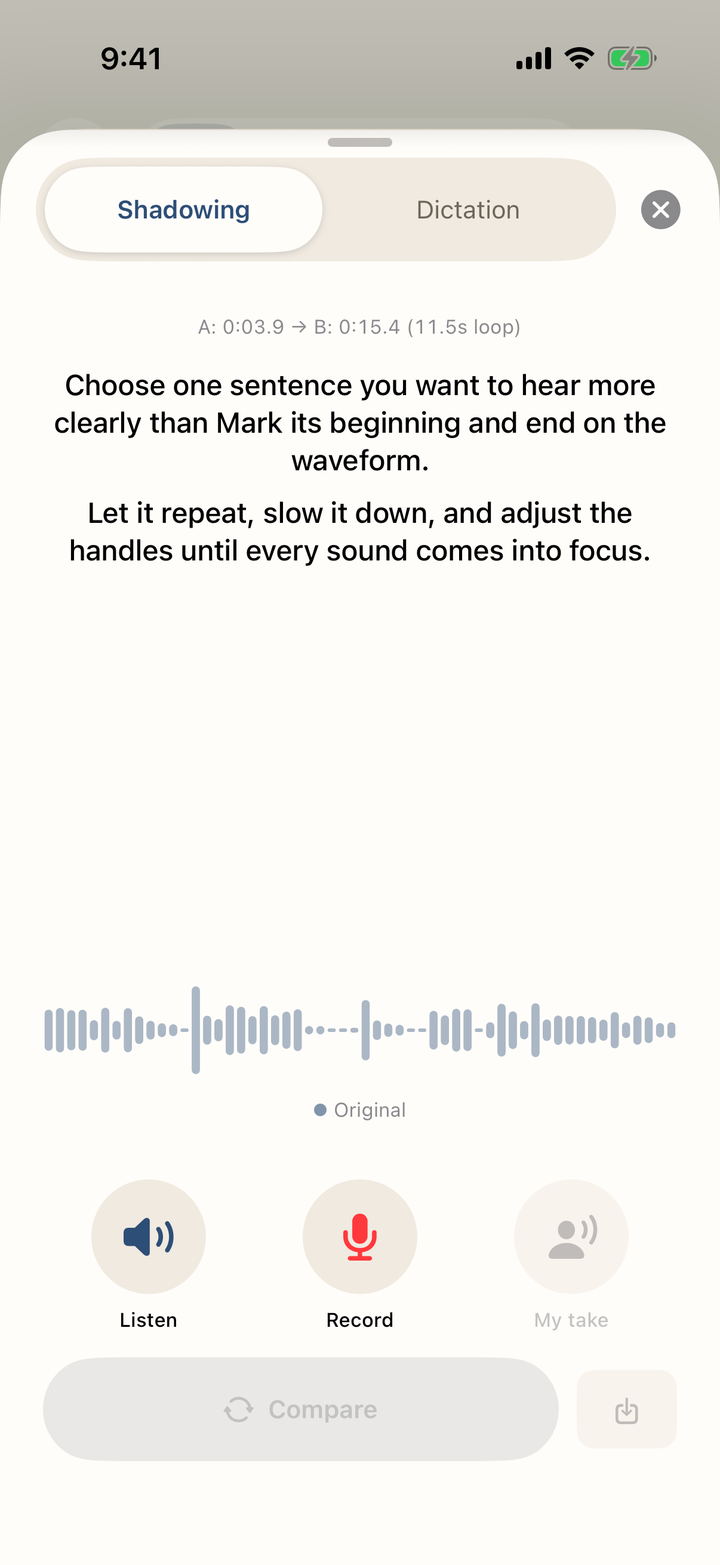 ▲ Listening, recording, and comparing your voice against the original
※ The screenshot above is a 4.0.0 example. See 12-2 and 12-3 below for the speed control beside Listen and playback progress added in 4.1.0.
12-1. Shadowing Gap
This practice mode does not require recording.
- Set an A/B range.
- Turn on the shadowing gap button.
- After the range plays, speak during the silent gap.
- When the countdown ends, the original plays again.
This works with audio files, videos, and YouTube streams.
12-2. Recording and Comparison
Recording and comparison are Premium features.
- Set an A/B range.
- Tap Practice in the fixed tool row.
- Choose Shadowing at the top, then use Listen to hear the original.
- Tap Record to record your voice.
- Use My take to hear only your recording.
- Use Compare to hear the original and your take back to back.
The first time you use it, Phrabbit asks for microphone permission. Recordings are stored on your device.
For audio files, you can see the original waveform and your recording waveform together. For videos and YouTube streams, Phrabbit cannot access the original waveform, so only your recording waveform is shown.
Use the speed button beside Listen to play the original at 0.5×, 0.75×, 1×, 1.25×, 1.5×, or 2×. Shadowing opens at the main player’s speed. Your choice applies to Listen and the original part of Compare; My take and the recorded part of Compare keep the pace of your recording. Speed cannot be changed while recording. Closing Shadowing returns the main player to its speed before practice.
12-3. Practice with Subtitles
When subtitle cards overlap the selected A/B range, their text is passed into the practice screen. This also works with loaded YouTube subtitles and local-video subtitles. Shadowing can display the reference while listening; Dictation keeps the answer hidden until checking. If no subtitle reference is available, you can still listen and record.
For audio-file shadowing, a vertical line on the waveform shows the current playback position. While listening to the original, the reference text highlights through the spoken word when word timings are available; otherwise, the current sentence is highlighted as a whole. These audio-specific progress displays do not apply to video or YouTube shadowing.
12-4. Saved Recordings
Use the save button to keep a take. Open the original material’s My Recordings tab to find saved recordings. Takes of the same A/B range are grouped together.
Tap a saved recording to return to the A/B range where it was made and reopen the shadowing screen. Multiple takes for the same range are grouped as one practice point.
To manage a saved recording or bookmark, tap ⋯ at the end of its row or card, or touch and hold it. Both open the same menu; swiping does not delete saved practice. Choose Info to see a bookmark’s range, length, and saved date, or a recording’s range, length, take count, and recording dates.
13. Dictation
Dictation is a Premium practice mode for listening to an A/B range one unit at a time, writing what you hear, and comparing it with the original. It works with audio, video, and YouTube, and is also available during the free trial.
13-1. Start Dictation
- Set the A/B range you want to practice.
- Tap Practice in the fixed tool row.
- Choose Dictation at the top. Phrabbit remembers the last practice mode you used the next time you open it.
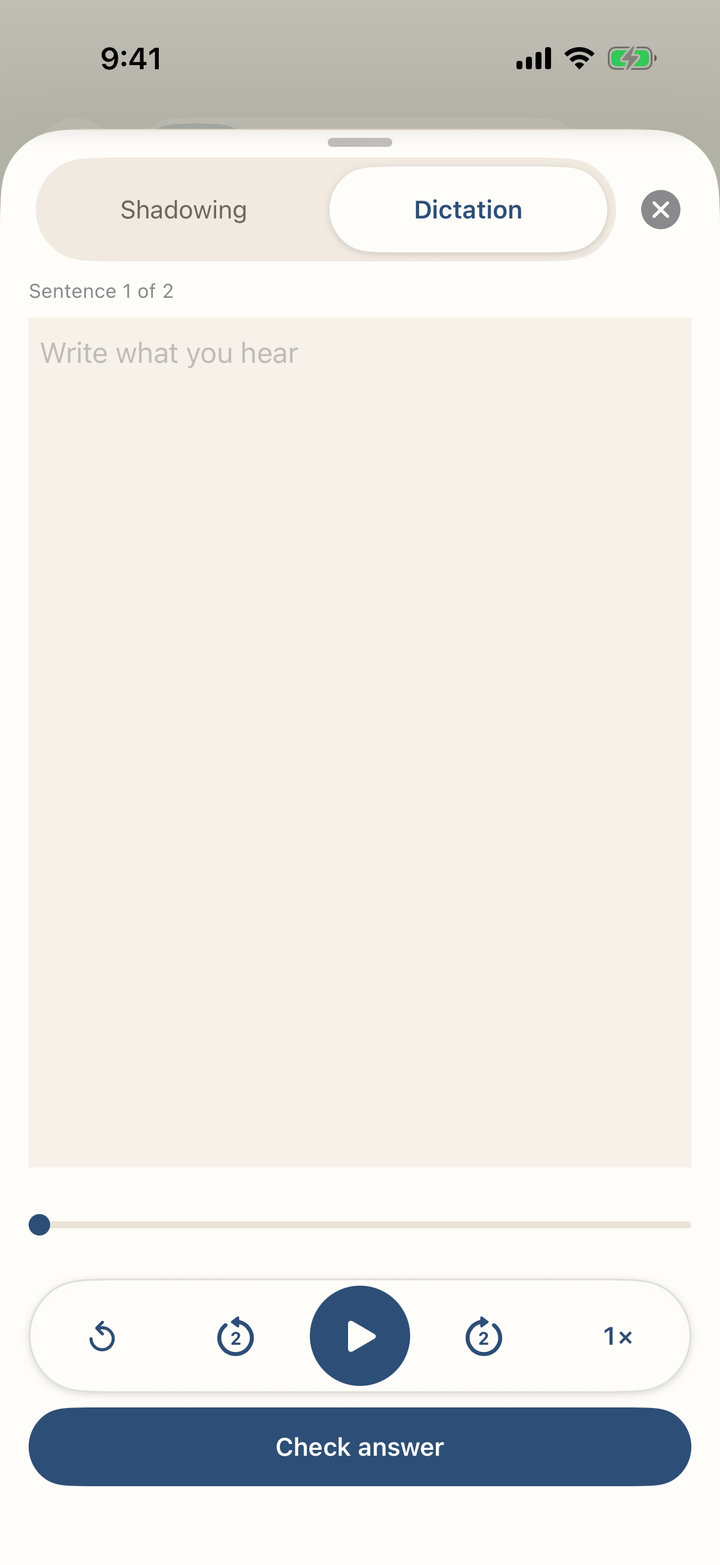 ▲ The practice sheet with Shadowing / Dictation at the top, Dictation selected
When loaded subtitles are available, they provide the answer reference. Audio can offer sentence-by-sentence units; video and YouTube practice the selected A/B range using its subtitle reference. Without subtitles, enter an answer yourself or check the video. Dictation starts from the normal player, not from full-screen practice.
13-2. Listen and Write
Use Listen to hear the current sentence once, then type what you heard. You can play or pause, move back or forward 2 seconds, and adjust speed. Tap the speed button to show all six choices from 0.5× to 2×. When you are ready, tap Check answer.
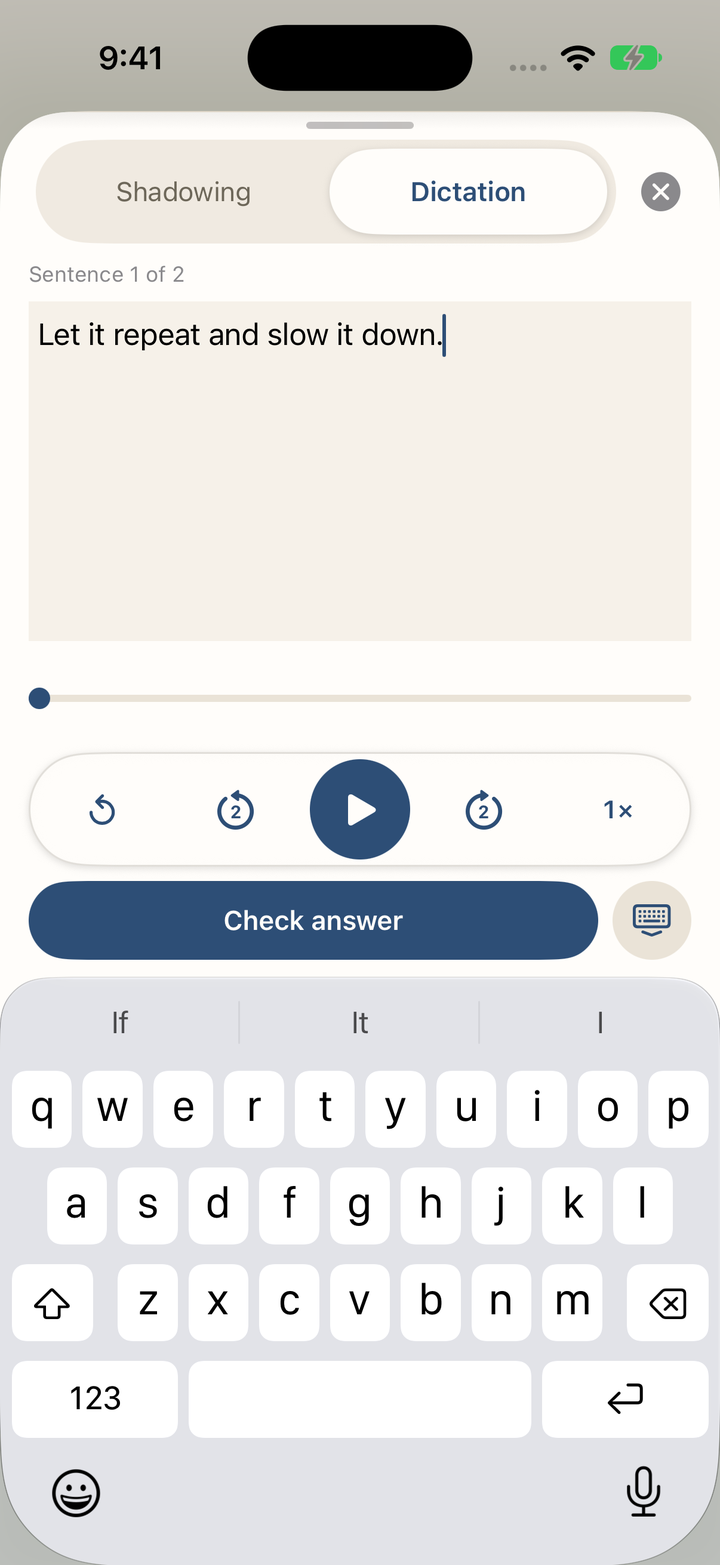 ▲ Typing the sentence, with the transport, speed, and Check answer above the keyboard
In a wide iPad window, you can switch between Keyboard and Handwriting. The handwriting page includes pen color, highlighter, eraser, undo, clear-all, and finger-drawing controls. Your strokes are saved, but Phrabbit does not read or grade handwriting, so compare it with the original yourself. Your input-mode choice is remembered for the next session. A narrow Split View or Stage Manager window shows keyboard input only.
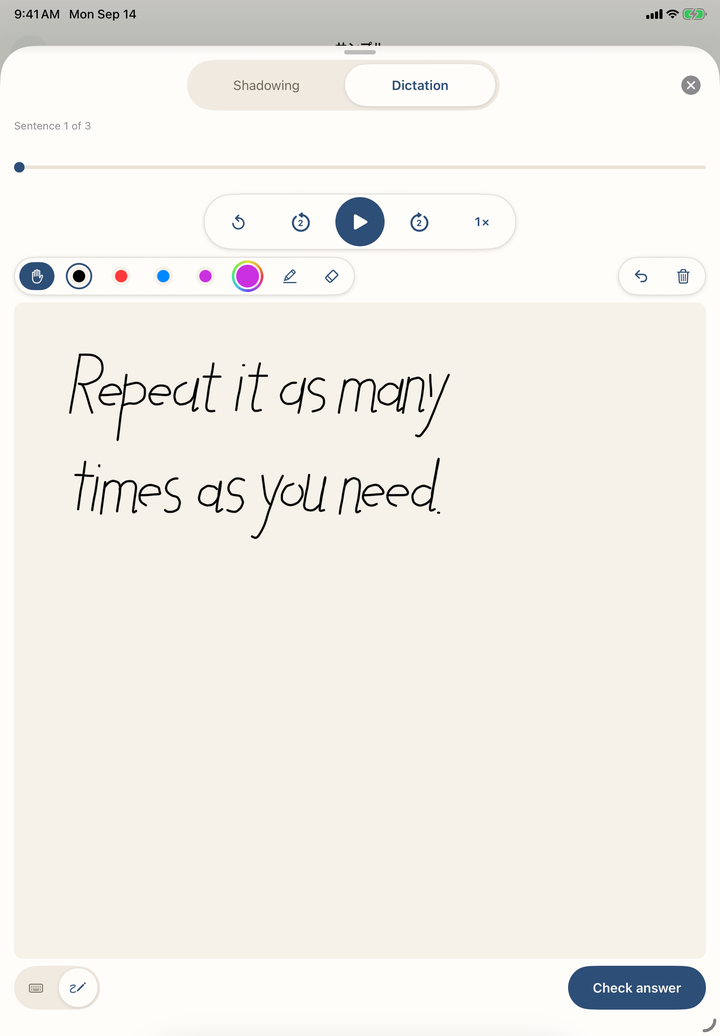 ▲ The handwriting page on a wide iPad window: pen colors, highlighter, eraser, undo and clear-all above the paper, with the Keyboard / Handwriting switch at the bottom left
13-3. Check and Grade
When subtitles or an answer you saved yourself are available, Phrabbit compares your writing with the original and marks the differences. For newly transcribed audio, if the A/B range cuts through a sentence, word timings let Phrabbit compare only the part you actually heard. Automatic comparison may be withheld for a cut sentence that has no precise word timing. In that case, Whole sentence restores comparison by practicing the full sentence, and My range returns to your original range.
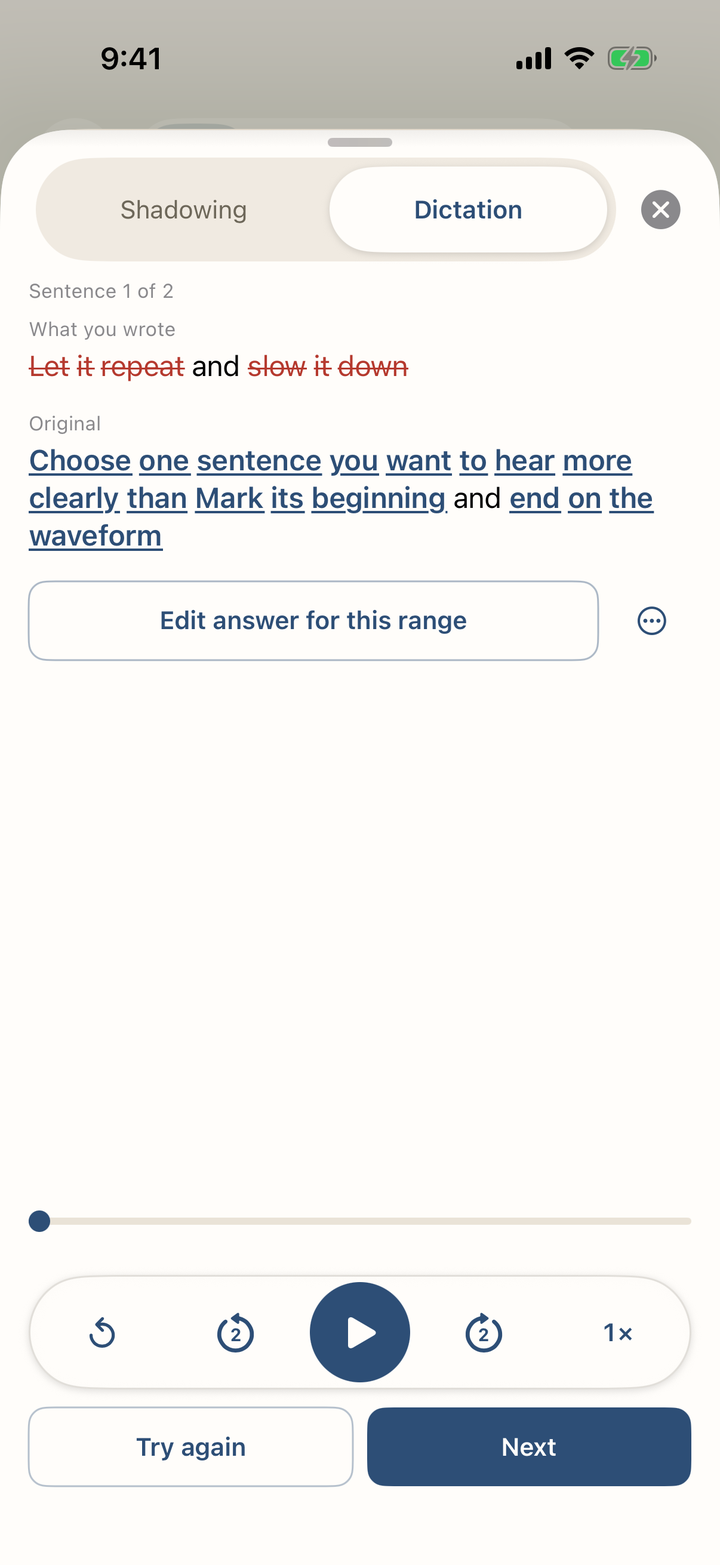 ▲ Differences marked against the original, with Try again and Next
Without subtitles, check the video or use Type the answer to enter the sentence you heard as the answer for this A/B range. On a YouTube video with no captions, that answer is also added as the range’s subtitle card (see 10-2). Edit answer for this range changes only your saved answer key; it leaves subtitles and previous writing intact. The exception is a YouTube video where one subtitle line you typed has the same start and end as the practice range: the answer and that line are one, so saving also changes the line in the Subtitles tab. You can revert to the current subtitles, or remove the typed answer if there are none. A separate Edit subtitle action edits the subtitle itself. Restore original text fills the editor with the original; save to apply it. Recognition and auto-generated YouTube subtitles can be wrong, so check the reference before relying on the comparison.
On iPhone or a narrow iPad window, Check in the video lowers the dictation sheet so you can use the video and its YouTube controls directly. A wide iPad opens a dedicated practice workspace instead: the video is hidden while you write and returns above the comparison when you check the answer.
After checking, choose Try again to put the same question at the end of the session, or Next to move on. The last question shows Finish.
13-4. Review and Practice Again
A session is saved automatically when you close it after writing or checking at least one answer. Open the original material’s Dictation tab to review attempts grouped by A/B range.
Open a record to review what you wrote, its original text, the automatic comparison, and any saved handwriting. If you practiced the range more than once, Attempt chips move between earlier tries. Use Practice again to reopen the same range, or delete an attempt you no longer need. Saved attempts remain readable after Premium ends, but starting a new dictation session requires Premium or the free trial.
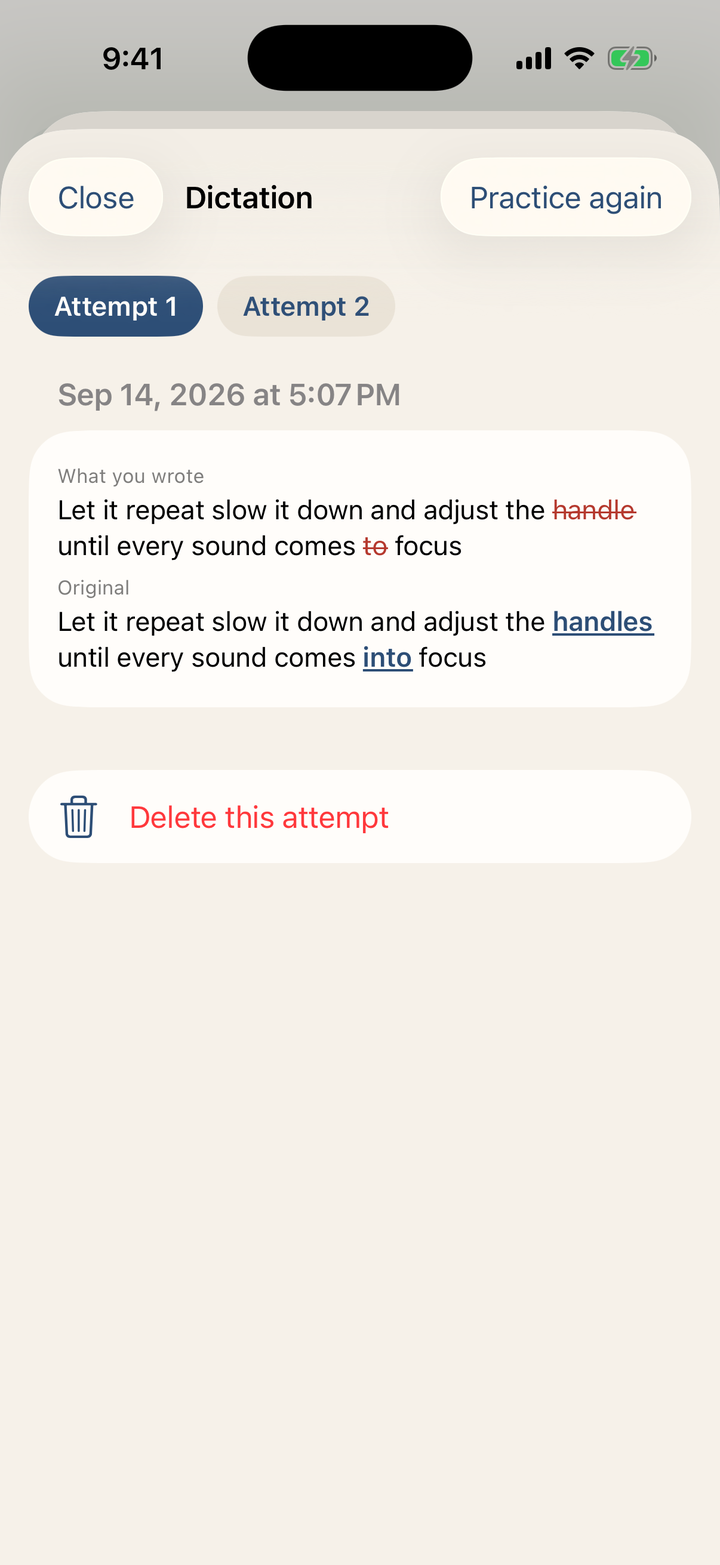 ▲ A saved record: Attempt chips, what you wrote, the original, and Practice again
Time spent listening and writing in Dictation counts toward learning stats. Tracking pauses when you leave the app, and it stops automatically after a long period without interaction.
14. Podcasts
Podcast downloads are a Premium feature. You can search by show name, browse recommendations for your practice language, or import episodes from Apple Podcasts subscriptions and RSS URLs, then practice them in the audio player.
14-1. Browse by Practice Language
Tap Add from Podcast in the Home plus menu. The first time, choose the language you want to practice. Phrabbit has hand-picked lists for Korean, English, Japanese, Chinese, Spanish, and French, and other practice languages are available too.
After choosing a language, topic chips and show rails appear under Browse in …. Learner shows and current news are selected first. Turn chips on or off to add or hide lists such as beginner, slow speech, history, travel, or music. Each language shows only topics with useful search results. Use Change language at any time.
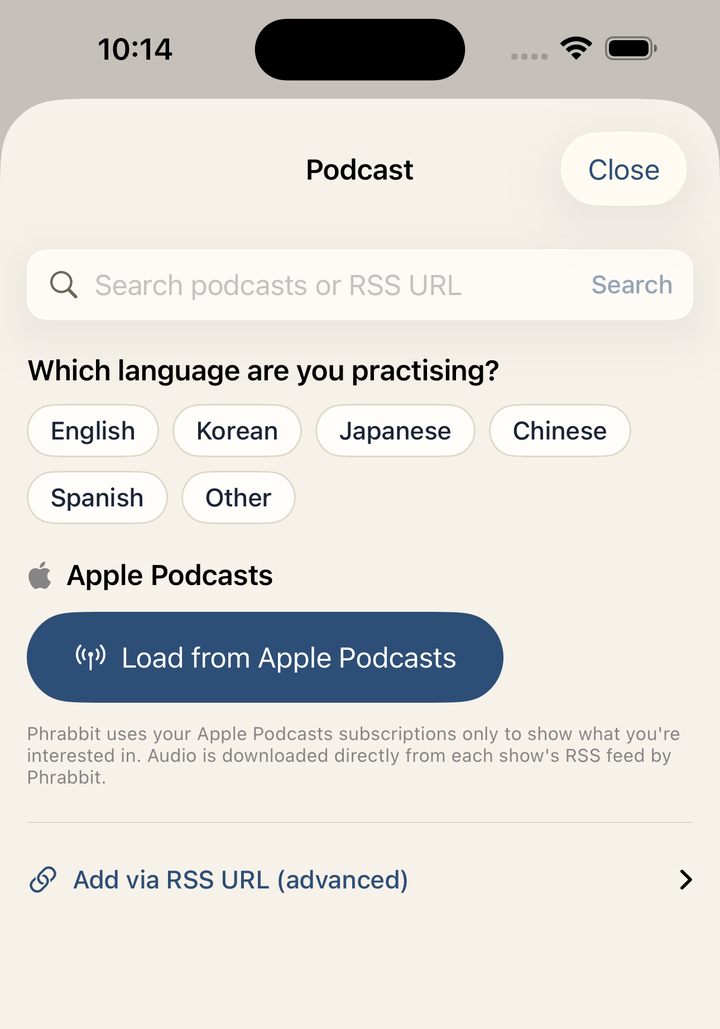 ▲ The first visit asks which language you are practising
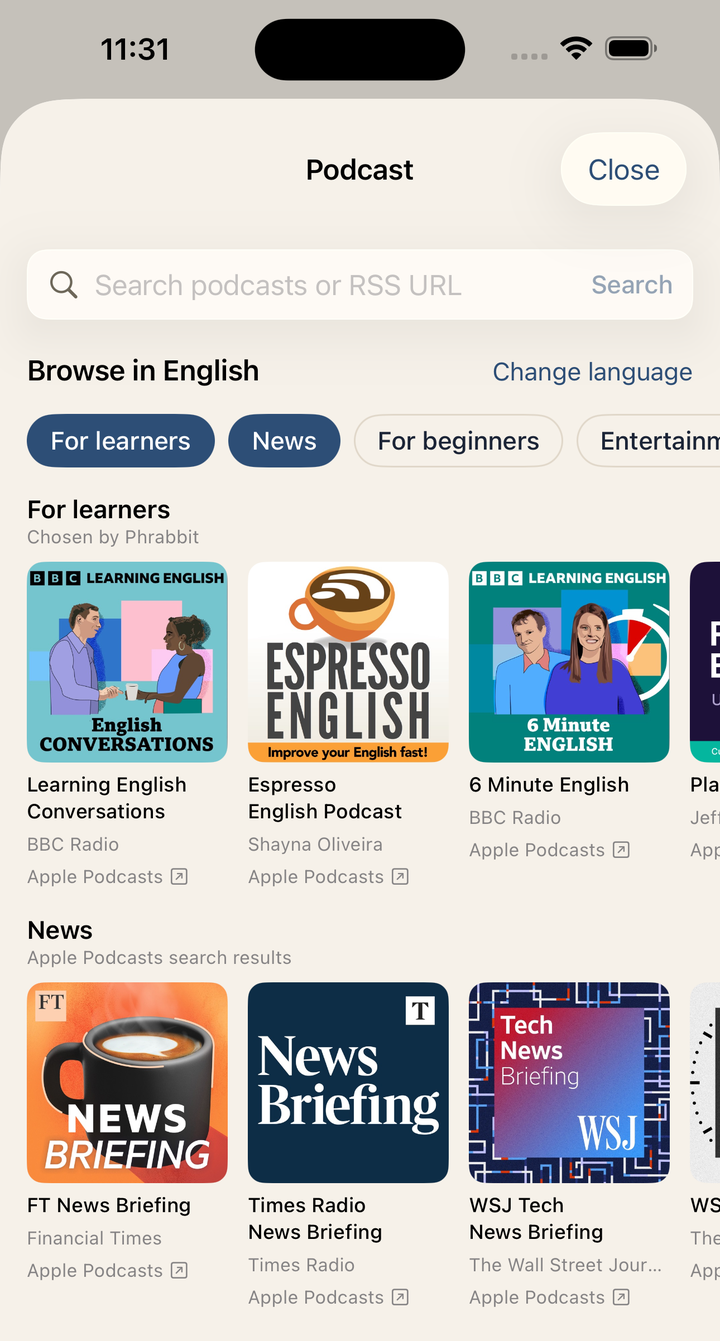 ▲ Topic chips filter the rails; each rail scrolls sideways
Chosen by Phrabbit marks a hand-picked list; Apple Podcasts search results marks an Apple search. A badge such as “Taught in English” means the show teaches the practice language using another language.
14-2. Search by Name or RSS URL
Enter a show name in Search podcasts or RSS URL and search. Tap a show card to open the same episode list used by every other entry point. You can also paste an RSS URL directly into this field to open that feed.
14-3. Apple Podcasts Subscriptions
Phrabbit may ask for media library permission. Tap Load from Apple Podcasts and allow access to show your subscriptions under My podcasts. Phrabbit uses this permission only to display shows you are interested in; it downloads episode audio directly from each show’s RSS feed.
Tap a channel to open its episode list.
14-4. Episode Badges
| Badge | Meaning |
|---|---|
| Creator captions | Official time-synced captions are available |
| Creator transcript | Official text-only material is available |
| No badge | No official transcript |
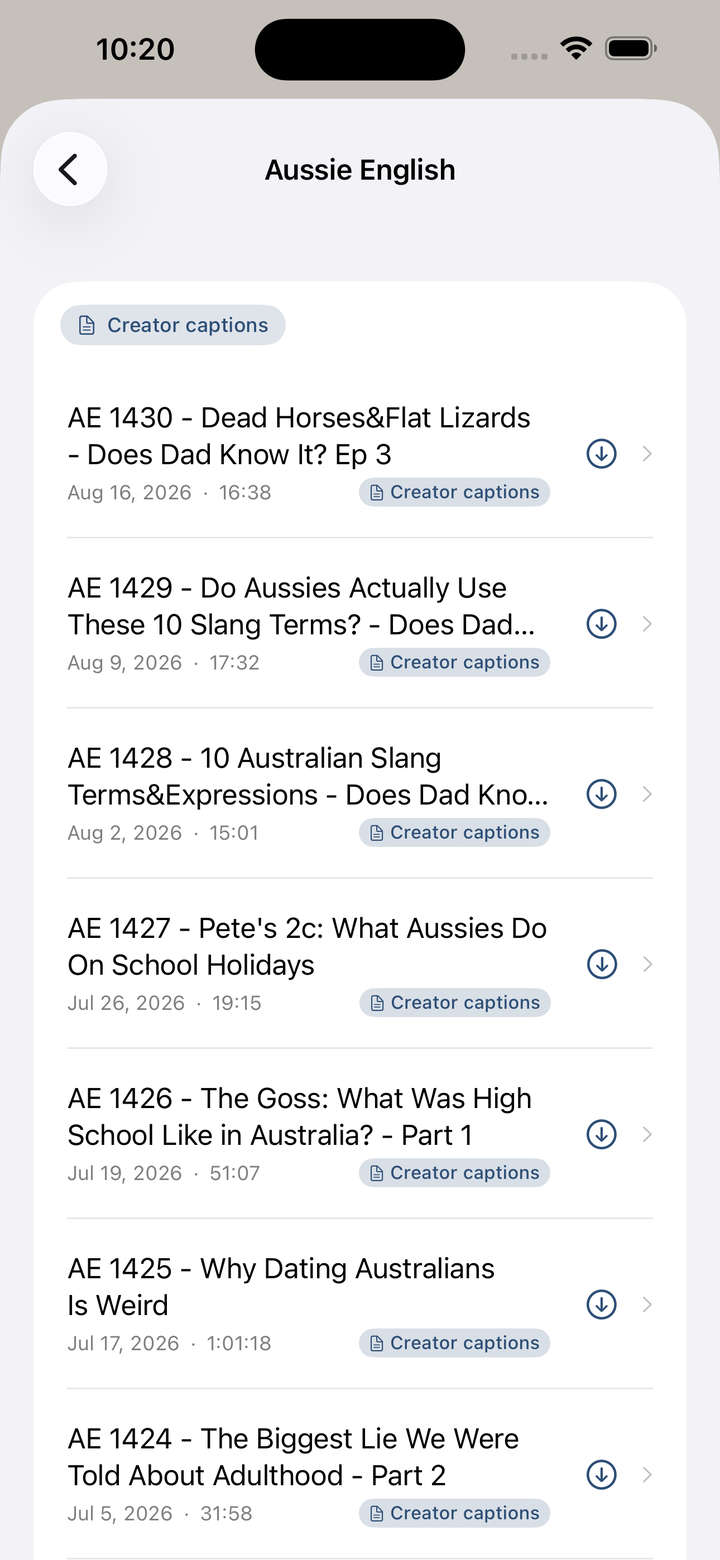 ▲ Episodes with a Creator captions badge can import official captions
Episodes with the Creator captions badge can import the podcast’s official captions without running STT again. This is usually more accurate than automatic recognition and requires less waiting, so those episodes are recommended first for study material.
14-5. Enter an RSS URL Directly
Besides pasting an RSS URL into the search field, you can expand Add via RSS URL (advanced) and enter it manually. Use this for podcasts that do not appear in Apple Podcasts search or when you already know the RSS address.
14-6. Downloads and Cellular Data
The default setting is Download over Wi-Fi only. If you allow cellular downloads, a confirmation may appear before downloading a large episode.
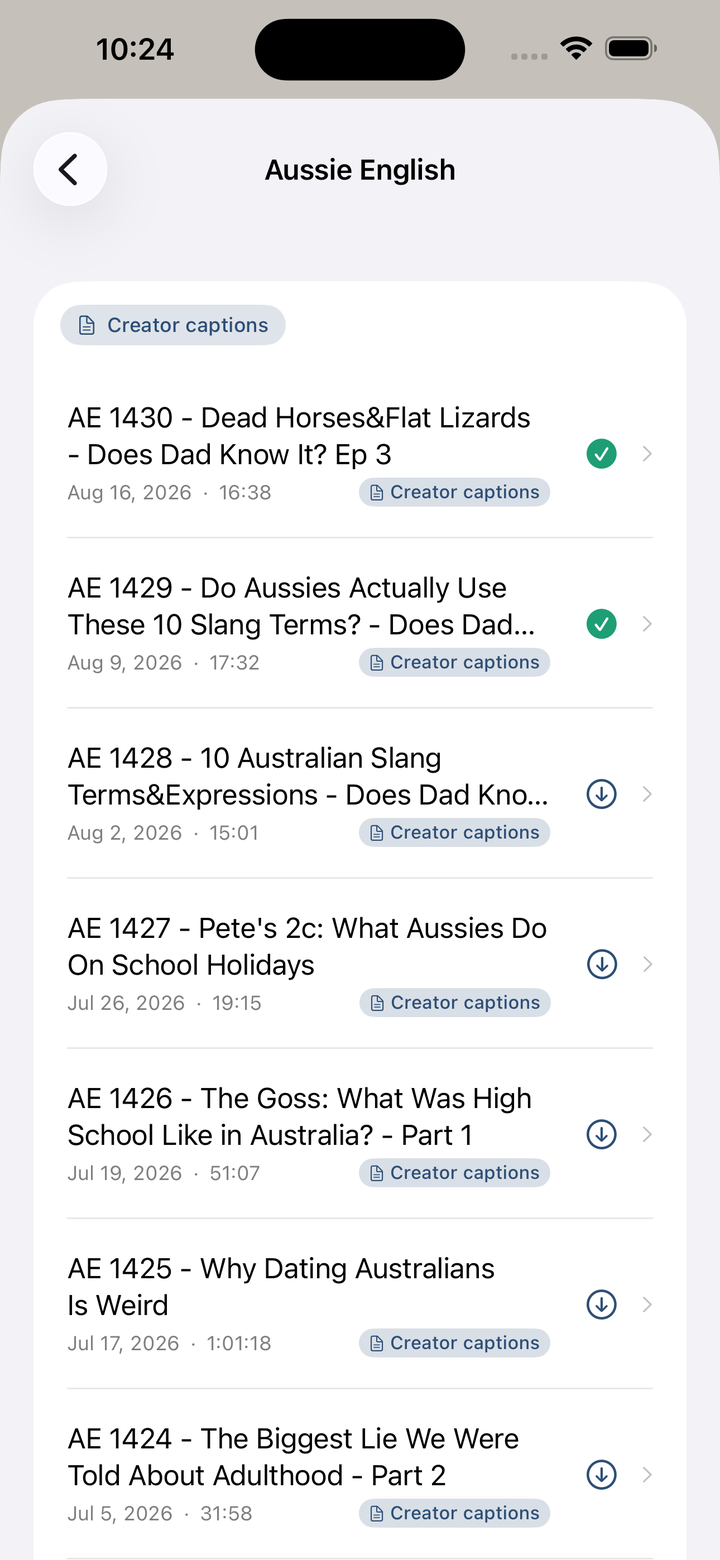 ▲ Episode list showing not-downloaded and downloaded states
Tap an episode to start downloading. While it downloads, tap the stop square inside the progress ring to cancel. If a clock indicates that the episode is waiting for Wi-Fi, tap the episode again to remove it from the queue. Tap an episode with a check mark to open the player.
Some podcast files may take a moment to prepare in a playable format the first time you open them. When an episode has official or STT subtitles, supported devices can translate them using 8-3. Translate All Subtitles.
15. Learning Stats and Settings
15-1. Progress Tab
In the Progress tab, you can check your recent practice activity.
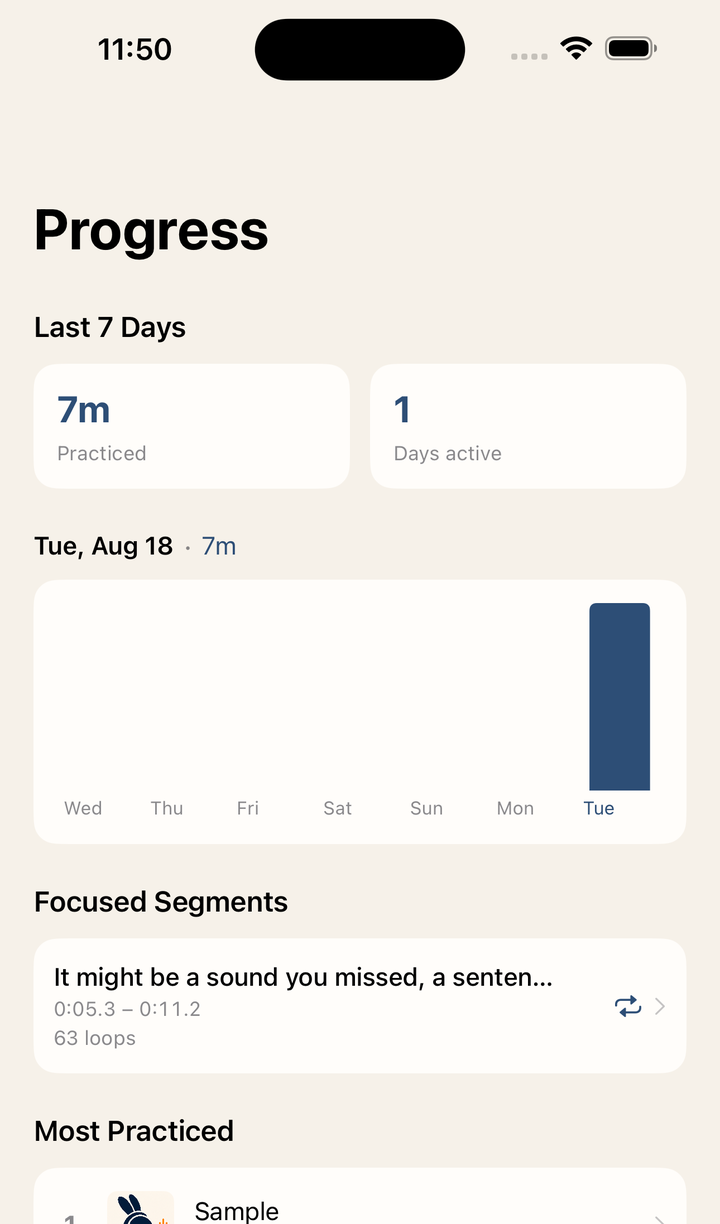 ▲ Recent 7-day activity and frequently repeated segments
Main items:
- Last 7 Days - Practice time and active days in the last 7 days
- Bar chart - Practice time by date
- Focused Segments - Recently repeated practice sections
- Most Practiced - Audio, video, or YouTube items practiced most often
- All Time - Total accumulated practice time
Tap a Focused Segments or Most Practiced item to return to the original material and practice again. Time spent actively practicing in Shadowing and Dictation is included. Stats are recorded only for practice after this feature was added.
15-2. Settings
Tap More at the top right of Home, then choose Settings.
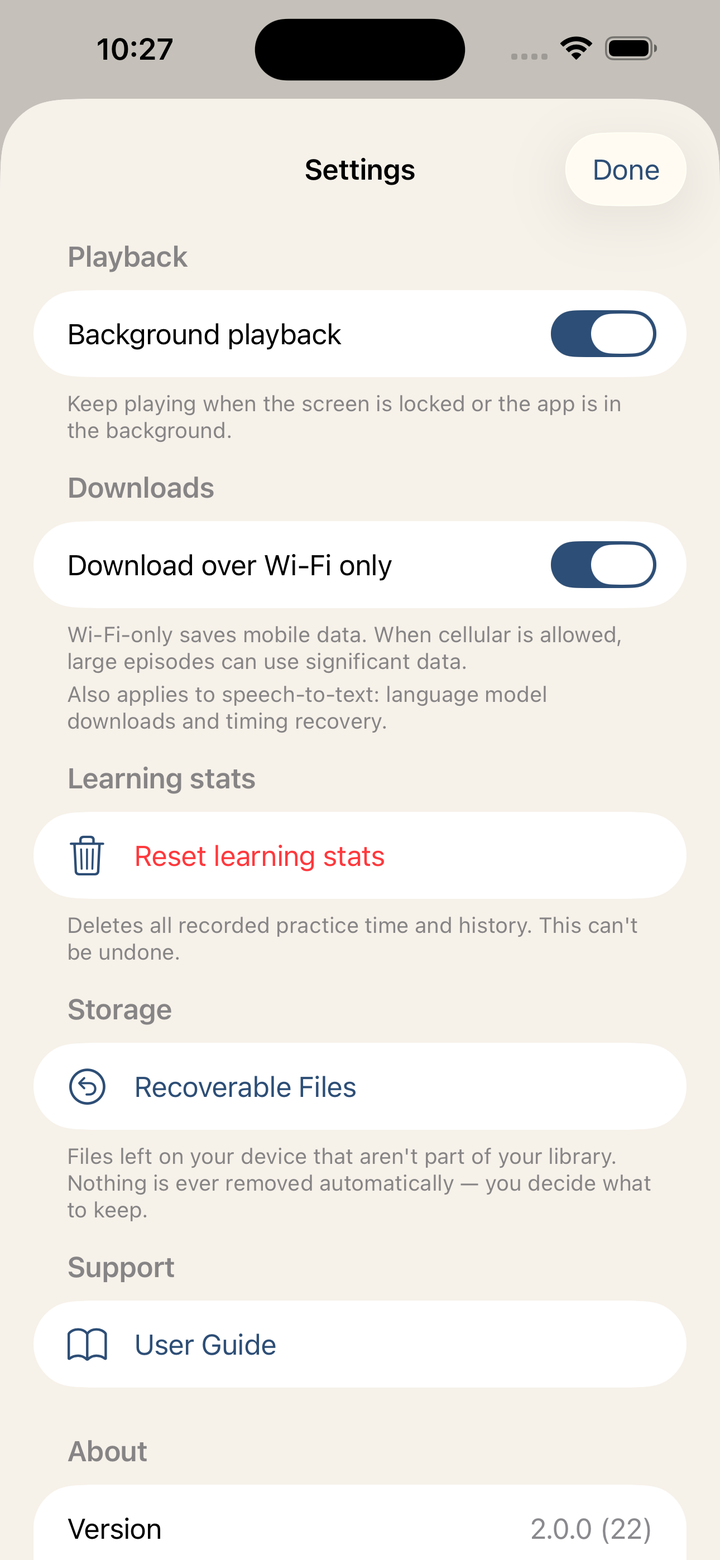 ▲ Settings for background playback, downloads, learning stats reset, and support
You can manage:
- Background playback - Lock screen and background audio playback for Premium users
- Download over Wi-Fi only - Applies Wi-Fi preference to podcast downloads, STT model downloads, and timing recovery
- Ask before cellular download - Confirms before downloading over cellular
- Reset learning stats - Deletes learning stats
- Rate Phrabbit - Opens the App Store review screen
Resetting learning stats cannot be undone.
16. Free vs Premium
Available for Free
- Import local audio files
- Import DRM-free Music library tracks
- Add YouTube links and practice A/B loops
- Add video files and practice A/B loops
- Load subtitle files (SRT, VTT, SMI) for videos
- Waveform view, time ruler, and A/B looping
- Loop count and playback speed controls
- Shadowing gap
- Sleep timer
- Create 1 new audio bookmark per file
- Create 1 new video bookmark per video
- Open existing audio bookmarks saved during Premium or the free trial
- Hide subtitle cards on audio, local video, and YouTube when subtitles are available; edit audio sentence timing
- Display translations imported from a bilingual video subtitle file
- Learning stats
Available During Premium or Free Trial
- YouTube subtitle card practice for videos with subtitles (loading new subtitles and changing tracks)
- Speech-to-text (STT) subtitle conversion
- Real-time subtitle and waveform sync
- Wordbook
- Apple Intelligence explanations on supported devices
- Unlimited audio bookmarks
- Unlimited video bookmarks
- Scene transcription for videos
- YouTube stream bookmarks
- Podcast downloads
- Shadowing recording, comparison, and saved takes
- Dictation, automatic comparison, saved attempts, and iPad handwriting
- Full-subtitle Apple Intelligence translation on supported devices
- Audio background playback and lock screen controls
Payment
Phrabbit Premium is a one-time purchase. It is not a subscription. After purchase, you can keep using Premium with the same Apple ID. If you change devices, use Restore Purchase on the Premium screen.
17. FAQ
Q. Can I import songs from my Apple Music subscription?
A. No. Songs downloaded through an Apple Music subscription are protected by DRM and cannot be used in other apps. Only DRM-free tracks purchased from the iTunes Store or imported from a CD can be used.
Q. Speech recognition is inaccurate.
A. First check that the selected STT language matches the actual audio language. Background music, noise, and overlapping speakers can make recognition difficult. For important sections, edit the subtitle manually or use Add Segment.
Q. Does STT continue if I leave the app?
A. No. STT conversion currently needs the app to stay open. If you lock the screen or move to another app, conversion may stop. Audio background playback and STT conversion are separate features.
Q. Why is there no automatic comparison in Dictation?
A. Automatic comparison needs a usable subtitle reference or an answer you saved. Loaded YouTube cards can supply that reference too. A range cutting a sentence without precise timings may require manual checking. Use Whole sentence when offered or save an answer for the range. Handwriting is saved as strokes and always checked manually.
Q. Does audio continue on the lock screen?
A. Premium or the free trial and Background playback must be active. On the lock screen, Control Center, or compatible earphones, use play/pause and previous/next: they move between sentences, or bookmarks while Play All is active. Without subtitles, sentence movement falls back to five-second skips. Turning background playback off or ending the trial pauses audio when the app enters the background.
Q. Does adding a video use up storage?
A. No. Video files are not copied into the app; Phrabbit keeps only a link to the original file, so a large video uses almost no app storage. In exchange, playback stops working if the original is moved, renamed, or deleted, or if it is offloaded from iCloud Drive. Use Re-link File to point Phrabbit at the file again.
Q. A video shows “File missing”.
A. The original file has been moved, renamed, or deleted, or it is no longer downloaded on this device. Open the video and tap Re-link File, then choose the file at its new location. Bookmarks, subtitles, and progress are kept. If the file is gone for good, use Remove.
Q. My MP4 will not play.
A. The container is supported, but the video or audio inside may use encoding this device cannot decode. Converting it to H.264 or HEVC video with AAC audio fixes it. If the message mentions hev1, the file is HEVC but packaged in a way iOS cannot play - repackaging (remuxing) it as hvc1 is enough and does not re-encode the video.
Q. Does video continue playing in the background?
A. No. Video playback stops when the app goes to the background or the screen locks. Background playback applies to audio files only.
Q. Does YouTube continue playing in the background?
A. No. YouTube streams do not support background playback. Phrabbit pauses the video when the app goes into the background, remembers the position, and restores it when you return.
Q. A YouTube video will not play inside the app.
A. Some video owners do not allow playback outside YouTube, so those videos cannot play in the embedded player. In that case, they cannot be used in Phrabbit.
Q. Is my data sent over the internet?
A. Wordbook entries, bookmarks, subtitles, and recordings are stored on your device. STT uses on-device models when possible. Depending on language, iOS version, and model installation state, Apple’s speech recognition service or model downloads may be required. Download over Wi-Fi only also applies to model downloads and some network-based recovery. YouTube videos play through the YouTube embedded player.
Q. Is Apple Intelligence explanation always accurate?
A. No. It is a beta feature and can be wrong. Before saving to Wordbook, check the meaning, examples, and explanation yourself and edit anything necessary.
Q. I do not see AI Explanation.
A. This feature requires iOS 26 or later, a device that supports Apple Intelligence, Apple Intelligence enabled and ready, and supported study and device languages. If the study language cannot be determined, or if the language is not supported by the model, the section may not appear. When the languages are the same, iOS translation may also be unable to create a separate translation, so type it manually if needed.
Q. Where are saved recordings?
A. Open the original material and select My Recordings. The Dictation tab holds saved dictation attempts. Deleting the original item also deletes its linked practice history; deleting a video item does not delete the original video file.
Q. Will my study data move to a new device?
A. Study data is currently stored on the device by default. Restore Purchase with the same Apple ID restores Premium, but Wordbook entries, bookmarks, subtitles, and recordings do not automatically move to another device.
Questions or problems? Email phrabbit.support@gmail.com. If the app showed you an error code, please include it — it tells us exactly where the problem happened.